
Thin cream, cream and anhydrous cream
According to “GB 19646-2010 Food Safety National Standards Thin cream, cream and anhydrous cream”:
1. Thin cream cream:
Milk as raw material, separated from the fat-containing parts, with or without the addition of other raw materials, food additives and nutrient enhancers, processed fat content of 10.0% -80% of the product.
2. Cream (butter) butter:
Milk and (or) thin cream (fermented or unfermented) as raw materials, with or without the addition of other raw materials, food additives and nutrient enhancers, processed fat content of not less than 80% of the product.
3 anhydrous cream (anhydrous butter) anhydrous milkfat:
Milk and (or) cream or thin cream (fermented or unfermented) as raw materials, with or without the addition of food additives and nutrient enhancers, processed fat content of not less than 99.8% of the product.
4. Physical and chemical indexes of thin cream, cream, anhydrous cream: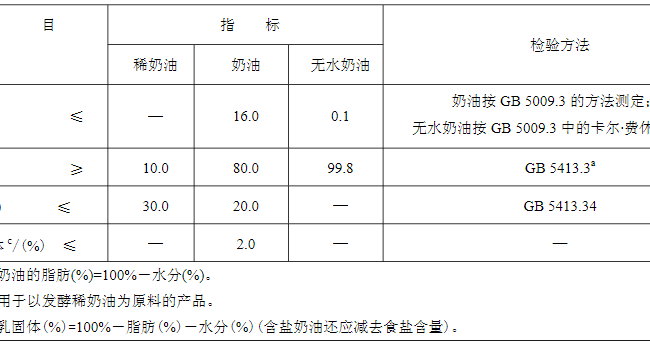
5. Through the standard we can find out:
5.1 Thin cream, cream, anhydrous cream main raw material is animal milk
5.2 The difference between thin cream, cream, anhydrous cream is: the use of different raw materials, different fat content
5.3 Cream = butter, anhydrous cream = anhydrous butter
Vegetable Cream
According to the provisions of “SB/T 10419-2017 Vegetable Cream”:
1.Vegetable fat cream:
Products made from water, sugar, edible vegetable oil, edible hydrogenated oil, dairy products (e.g. cream, milk powder) and several of them as main raw materials, with or without adding other auxiliary materials and food additives, through the process of batching, emulsifying, sterilizing, homogenizing, cooling, filling and so on.
2. Product Classification:
2.1 Vegetable fat type: products in which all the fats and oils used in the product ingredients are vegetable fats and oils.
2.1.1 Hydrogenated: the use of edible hydrogenated oil in the product ingredients made of vegetable fat products
2.1.2 Non-hydrogenated: Vegetable fat products made from non-hydrogenated edible vegetable oils used in product ingredients.
2.2 Milk-fat type: Products with milk-fat content added to the fats and oils used in the product ingredients.
2.2.1 Hydrogenated: products made from hydrogenated edible oils with a milk fat content in the product ingredients.
2.2.2 Non-Hydrogenated: Products containing milk fat in which non-hydrogenated edible vegetable oils are used in the ingredients.
2.3 Other types: in the production of products using other raw and auxiliary materials (or process) made of products
3 Physical and chemical indicators:
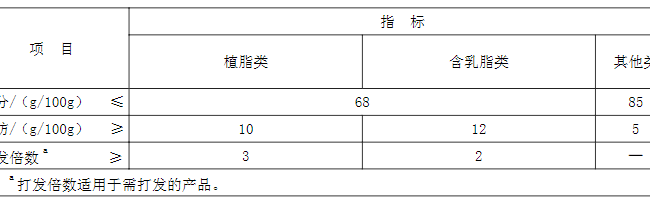
4 It can be found through the criteria:
4.1 Creams can be categorized according to the raw materials used: vegetable fats, dairy fats, and others.
4.2 Edible hydrogenated oils are a major ingredient in some of the vegetable creams, and there are also vegetable creams without edible hydrogenated oils.
4.3 Compared with thin cream, butter, anhydrous cream, may have a high water content, low fat content characteristics
Margarine
1. According to “LS / T 3217-1987 margarine (margarine)”:
Definition: Margarine refers to refined edible oil with water and other auxiliary materials added, emulsified by sharp cold kneading and synthesized into malleable products with the characteristics of natural butter.
2. According to the provisions of “NY 479-2002 Margarine”:
Classification: margarine according to the use can be divided into meal and food processing with two kinds of
2.1 Meal margarine:
Margarine spread on bread during meals for direct consumption or used for cooking.
2.2 Margarine for food processing:
Margarine used in factories for processing bread, snacks, ice cream and other products.
3. Physical and chemical indexes of margarine:

4. This can be seen through the criteria:
4.1 Margarine is characterized by a very high fat content and a low water content.
4.2 The main ingredients of margarine are refined cooking oil and water, and the product may not contain dairy products
4.3 Margarine = margarine
 English
  Danish
  German
  Hungarian
  French
  Russian
  Spanish
  Turkish