
Effect of functional sweeteners on the hardness of rice under different placement times
Rice hardness is the most intuitive data reflecting the quality of rice, and it is closely related to the straight ratio of dissolved in rice cooking.
After starch pasting, rice is very easy to undergo aging effect during storage, and the hardness of rice increases and the eating quality decreases.
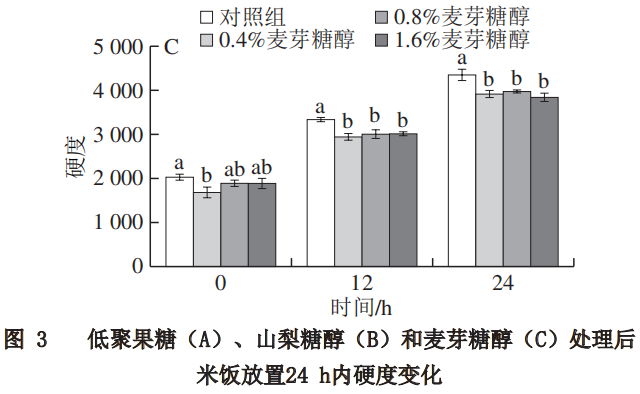
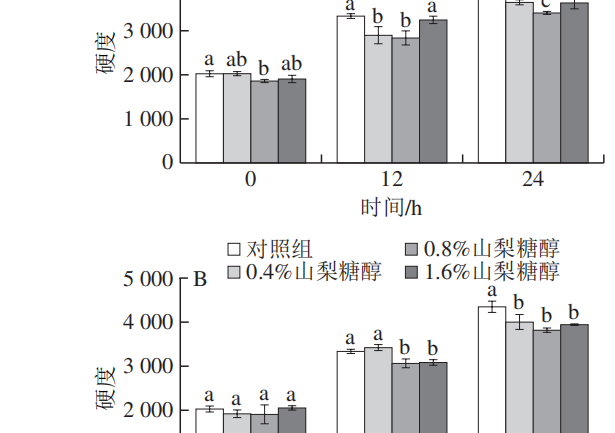
Oligofructose, sorbitol and maltitol all significantly delayed the hardening of rice
Cooked rice after steaming had the fastest aging rate within 24 h, and then leveled off at a later stage. Experiments were conducted to analyze the changes in hardness of rice treated with oligofructose, sorbitol and maltitol at 4 ℃ for 24h.
As can be seen from Figure 3, when the time was 0h, the difference in the hardness of rice was not obvious, but with the prolongation of the placement time, the hardness of the blank control group increased significantly, and it was significantly higher than that of the treated group after 24h (P < 0.05).
This reflects that oligofructose, sorbitol and maltitol all significantly delayed the degree of rice hardness. The change of hardness of rice during placement can reflect the regrowth of rice, therefore, the effect of inhibiting the regrowth of rice was significant in the oligofructose-treated group and the maltitol-treated group. The addition of 1.6% oligofructose resulted in a significant decrease in the hardness of rice after 24h of placement (P < 0.05), which was 21.79% lower than that of the control group, and the degree of regrowth was significantly lower than that of the control group and other treatment groups.
Oligosaccharides are small molecules that are easily soluble in water and can penetrate into the interior of starch granules with water during starch pasting, interacting with starch molecules to achieve the effect of inhibiting starch regrowth.
Related reading:
3 functional sweeteners are beneficial to increase the water absorption rate of rice soaking and improve the taste of rice
Oligofructose reduces straight-chain starch content in boiled rice and improves rice texture
 English
  Danish
  German
  Hungarian
  French
  Russian
  Spanish
  Turkish