
Dietary therapy is currently the main adjunctive treatment for diabetes, and its research focuses on low-GI foods. This paper discusses the current research progress on low-GI flour, low-GI noodles, low-GI pastries, and low-GI rice as foods for diabetes.
Diabetes mellitus is an endocrine metabolic disease that is co-featured by hyperglycemia and is caused by absolute or relative insulin deficiency. There is no cure for diabetes, and it is mainly controlled by a variety of treatments, mainly in the following five areas: education of diabetic patients, self-monitoring of blood glucose, dietary therapy, exercise therapy and drug therapy.
Diet therapy is the main adjunctive treatment for diabetes. In the study of dietary treatment of diabetes, the role of glycemic index (GI), which is an indicator of the degree of food-induced elevation of blood glucose in the human body, has received increasing attention.
The WHO Expert Committee defines GI as the ratio of the area under the glycemic response curve of a standardized food containing 50g of carbohydrates. Therefore, a diabetic diet should not only focus on the sugar content of the food, but also on its GI value. Usually GI below 55 is called low GI food. Conventional wheat flour, rice carbohydrates in more than 70% ~ 80% of polysaccharide molecules, its decomposition, metabolism, conversion are concentrated in the postprandial 1h ~ 2h time period, so the main research direction of low GI foods are two: ① control the decomposition rate of carbohydrates in the staple food; ② to change the content of carbohydrates in the staple food grain.
Low GI Flour and Noodles
Wheat has always been the most important staple food in northern China, and it is the “carbohydrate” in the three major food chains of fat, protein, and carbohydrate, and the supply and decomposition rate of carbohydrates in the 1h~2h period after a meal are the most direct factors that have the greatest influence on the postprandial glycemic elevation. Table 1 shows
summary of low-GI flour and pasta studies.

As can be seen from Table 1, literature 6, 7, 9, 9, 11, 12 developed low GI flour and noodles in food formulations introduced on the three highs have auxiliary therapeutic effect of the GI value of 59 buckwheat or buckwheat; literature 5, 8, 9 developed low GI flour and noodles in food formulations introduced low-sugar and high nutritional oats, literature 6, 7, 12 was introduced to the GI value of only 17 konjac flour, to further lower the GI value of the product.
From the composition of the formulas shown in Table 1, the other formulas other than Literature 6 have more or less added ingredients or herbs that have health effects on diabetes with a view to achieving better therapeutic effects.
Because of the inclusion of multiple ingredients or herbs in low-GI flour or noodle formulations, the retention of nutrients in each component of the formulation is particularly important. For this, each researcher used different methods.
Literature 8 used freeze-drying method in order to retain a large number of nutrients in vegetables. Literature 10 preparation method is as follows: all materials together into the deep-cooled pulverizer, at -14 ℃ ~ 12 ℃ within the pulverization process for 55min ~ 65min, through a 40-mesh sieve, and then, put the mixed powder into a CNC continuous steam explosion machine, 3MPa ~ 3.4MPa pressure steam explosion treatment for 4min ~ 6min, continuous steam explosion treatment at the same time with ultrasonic processing; and finally, the mixed powder into the mixing tank, add the mixed powder into the mixing tank, and then add the mixed powder into the mixing tank, add the mixed powder into the mixing tank, add the mixed powder into the mixing tank. powder into the mixing tank, add the appropriate amount of embedded protease 300rpm ~ 400rpm speed mixing 20min ~ 24min can be.
Low GI Confectionery
Confectionery is an important part of the Chinese diet, but most of the confectionery is high in oil and sugar, which is unsuitable for diabetic patients, so the researchers developed sugar-free low-GI confectionery for diabetic patients, and the studies are summarized in Table 2 .
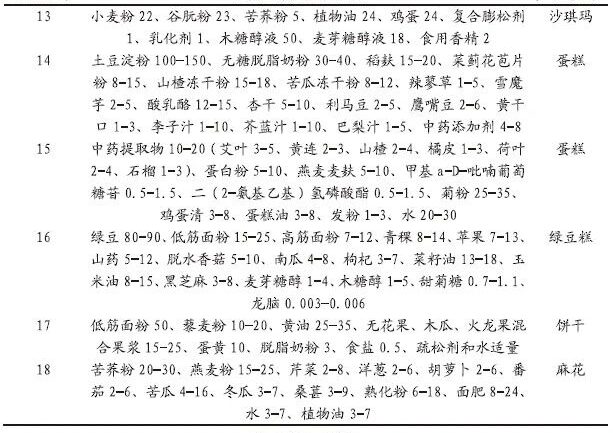
As can be seen from Table 2, each of the low-GI cake formulations excluded white granulated sugar, which has a high GI value of 83.8, and introduced a variety of ingredients with health benefits for diabetes, in order to achieve the synergistic effect of “1+1≥2”. The results of a human trial study in the literature15 showed that diabetic patients had stable blood glucose at 1h and 2h postprandial after consuming the cake with this formula. In the implementation of the high nutritional and low GI targets of the formulations, researchers have made various efforts.
Literature 13 uses gluten and buckwheat to replace part of the wheat flour in the formula, and xylitol and maltitol to replace sucrose and fructose, which increases the nutritional value and reduces the risk of post-consumption blood glucose spikes; Literature 14 replaces wheat flour with potato starch, which has a GI value of only 13.6, and solves the drawbacks of insufficient strength and poor water retention with a source of tendon power, and replaces white granulated flour with kefir cheese (which contains abbasi sweetness) and many kinds of fruit juices that are low in GI. GI fruit juices instead of sugar, and a variety of low-GI ingredients such as unsweetened skimmed milk powder improved the texture of the cake as well as added health benefits.
Literature17 introduced quinoa, figs, papaya, and dragon fruit with hypoglycemic effects to achieve low GI. Literature 18 uses buckwheat flour and oat flour instead of wheat flour, and introduces a variety of vegetables, which not only replenishes vitamins and trace elements but also helps to stabilize blood glucose.
Other Low GI Foods
The research and development of low-GI foods has mainly focused on pasta, and not much research has been done on rice and other ingredients. Table 3 summarizes the research on low GI foods from rice and corn.

The composition of the formulas in Table 3 shows that the researchers are of the same mindset: numerous combinations of staple ingredients in order to achieve both a lower GI value and nutrient content. Literature 19 is a rice-based bakery food with diabetic health benefits; Literature 22 is a vegan corn fiasco, while the products of Literature 20 and 21 are not directly edible.
Summary
Diabetic patients in order to control blood glucose often need to avoid food and diet control for a long time, and a long time of avoidance will lead to nutritional imbalance and add new diseases, low GI food for diabetic patients to provide a more reasonable dietary structure, which will help to control diabetes, but the development of low GI food is still in the beginning stage of the research, and there is still a long distance from the commercialization of low GI food, need to continue to work hard.

 English
  Danish
  German
  Hungarian
  French
  Russian
  Spanish
  Turkish