
Research on Non coumarin Components in Bai Zhi
Bai Zhi is a plant in the Umbelliferae family, Angelica dahurica (Fisch. ex Hoffm.) Benth Et Hook. f. or Hangbaizhi A dahurica (Fisch. ex Hoffm.) Benth. et Hook. f. var. formosana (Boiss.) Shan et Yuan’s dried roots. Spicy taste, warm nature. It has the effects of relieving symptoms, dispelling cold, dispelling wind and relieving pain, promoting nasal opening, drying dampness and stopping belts, and reducing swelling and pus. In clinical practice, it is used to treat colds, headaches, eyebrow pain, nasal congestion, runny nose, nasal congestion, nasal sinusitis, toothache, vaginal discharge, sore and painful sores, etc. Angelica dahurica is one of the commonly used bulk medicinal materials in clinical practice. According to statistics, up to now, 565 varieties of traditional Chinese patent medicines and simple preparations containing Angelica dahurica have been included in the traditional Chinese patent medicines and simple preparations prescription database, and 1836 prescriptions containing Angelica dahurica have been included in the traditional Chinese medicine prescription database. To elucidate its pharmacological substance basis, scholars have isolated and identified a series of coumarin components from Bai Zhi. In addition, there are literature reports that Bai Zhi contains abundant flavonoids, but there are currently no relevant reports on the isolation and purification of flavonoid monomers from Bai Zhi. In the preliminary systematic study of the chemical composition of Angelica dahurica, the research team found that in addition to a large amount of coumarin components, Angelica dahurica may also contain non coumarin components such as alkaloids and flavonoids. Using LC-MS guided separation technology, multiple structurally novel coumarin dimers were successfully discovered from Angelica dahurica, and the high polarity parts of the ethanol extract of Hangbai dahurica were studied. Sixteen pyrrole alkaloids were successfully isolated and identified. This article further reports the isolation and identification of non coumarin compounds from the water-soluble parts of Angelica dahurica.
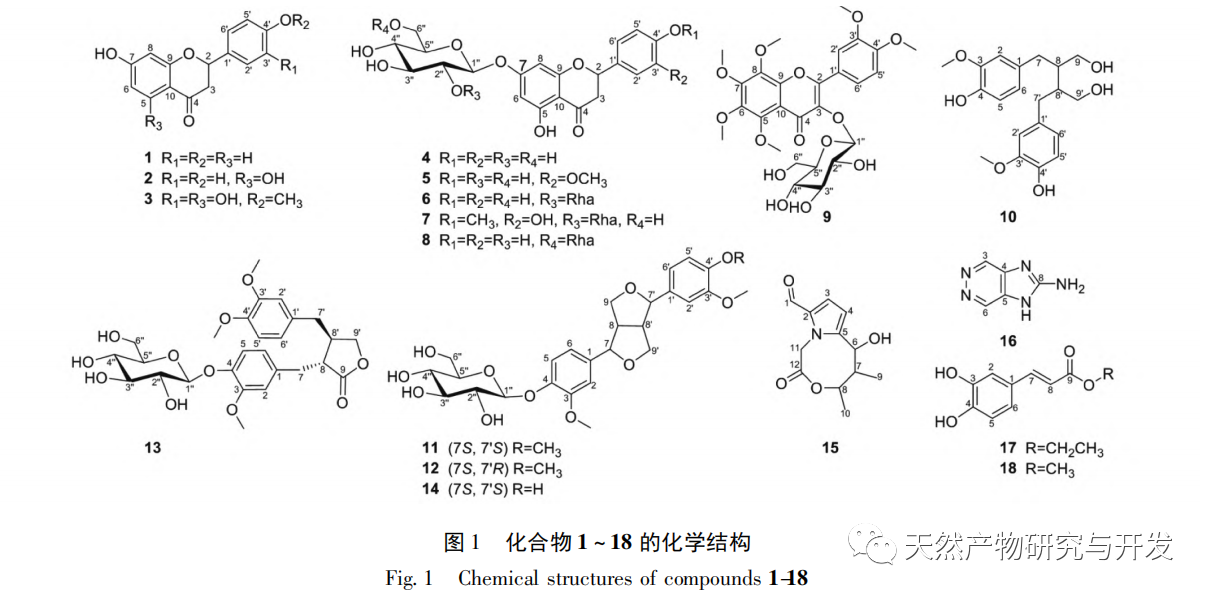 In the literature on the chemical composition of Angelica dahurica, it is generally believed that the main chemical components in Angelica dahurica are coumarin compounds, while there are few reports on non coumarin compounds in Angelica dahurica. Lu et al. once isolated and identified a pyrrolic alkaloid, coumarin, from Angelica dahurica. In our systematic study of Angelica dahurica, our research group not only isolated a large amount of coumarins and coumarin dimers, but also isolated 16 pyrrolic alkaloids from Angelica dahurica, enriching our understanding of its chemical composition. In further research on the chemical composition of Bai Zhi, 18 non coumarin components reported in this article were unexpectedly isolated. In addition to the previously reported Jin Qian Cao alkaloid, the other 17 non coumarin components, including 9 flavonoids, 5 lignans, 2 simple phenolic esters, and 1-H-imidazo [4,5-d] pyridazin-2-amine, were all isolated from Bai Zhi for the first time. Compounds 3 and 18 have certain inhibitory effects on zymosan induced release of superoxide from neutrophils, while compounds 1 and 18 have inhibitory effects on the release of NO activity from RAW 264.7 cells. It is worth noting that although there have been multiple literature reports on the presence of flavonoids in Angelica dahurica, they are all preliminary reports on the determination of total flavonoid content. Currently, there are no reports on the isolation of monomeric flavonoids from Angelica dahurica. However, in this study, multiple flavonoids and flavonoid glycoside monomers were obtained from Angelica dahurica for the first time, which surprised us greatly. We had doubted whether it was a problem with the medicinal materials, but further analysis of compounds 1, 6, 7, and 8 isolated and reported in this article was found in Angelica dahurica from three different origins, Hangbai, Chuanbai, and Yubai, using LC-MS. This indicates that compounds 1, 6, 7, and 8 can be detected in Angelica dahurica from different origins. Bai Zhi may indeed contain flavonoids. The research results have enriched the understanding of the chemical composition of Angelica dahurica and provided important references for its quality control and development and utilization.

 English
  Danish
  German
  Hungarian
  French
  Russian
  Spanish
  Turkish