
The Effect of Light Quality on the Growth and Synthesis of Bioactive Products of Isoflagellates
Marine microalgae are a multifunctional cellular factory that can synthesize various active products such as pigments, polysaccharides, and polyunsaturated fatty acids (PUFAs). They are widely used in food, medicine, feed, cosmetics, and other fields. Among numerous marine microalgae species, Isochrysis has the advantages of fast growth, high photosynthetic efficiency, strong synthesis ability of fucoxanthin and polyunsaturated fatty acids (PUFAs, such as octadecatetraenoic acid and docosahexaenoic acid), and no cell wall structure. It has attracted the attention of scientists and microalgae entrepreneurs and has been applied in the development of functional foods such as pasta, biscuits, and yogurt. There are research reports that fucoxanthin has been proven to have various pharmacological effects such as anti-inflammatory, anti obesity, anti-cancer, antibacterial, neuroprotective, promoting axonal growth, improving metabolism, and treating respiratory diseases; Polyunsaturated fatty acids can also improve diabetes and osteoporosis; Extracellular polysaccharides can promote metabolism and enhance the body’s immunity. Therefore, it is of great significance to develop fucoxanthin and polyunsaturated fatty acids for use in food using the same whip gold algae.
Light quality is one of the important factors affecting the growth and product synthesis of photosynthetic autotrophic microalgae cells. Different light qualities have different characteristics such as photon flux density and spectral wavelength, which affect the photosynthetic efficiency and carbon sequestration performance of photosynthetic autotrophic microalgae cells, exhibiting differences in cell growth performance and product synthesis. Previous studies have shown that there are significant differences in the selection of light quality among different sources of dinoflagellates. For example, Che et al. found that the highest oil content (62.5%) can be obtained by first culturing the dinoflagellate with mixed light (blue and red light) from the Korean Marine Microalgae Culture Center, followed by green light cultivation. Bu et al. found that Isochrysis zhanjiangensis exhibited the highest growth rate under red light conditions in Zhanjiang; However, microalgae cells cultured with green light have the highest chlorophyll content. It is worth noting that in the research on the effect of light quality on the synthesis of bioactive products by dinoflagellates, scientists only focus on the influence of light quality on the synthesis of a certain active product in dinoflagellate cells. However, as mentioned earlier, Chlamydomonas reinhardtii synthesizes fucoxanthin and polyunsaturated fatty acid active substances. Based on this, it is necessary to screen a suitable light quality through research work to achieve a balance between the synergistic synthesis of fucoxanthin and polyunsaturated fatty acids by Isoflagellates, so as to maximize the synthesis of their active substances by algal cells.
Previous research by our research group has shown that sustainable regeneration of oil and fucoxanthin can be achieved by using a semi continuous cultivation method (supplemented with nitrogen and phosphoric acid during the cultivation process) to cultivate Isochrysis sp. ISO-FJ in a pilot scale column type photoreactor (50L). Therefore, this study selected Isochrysis sp. ISO-FJ as the starting strain to investigate the effects of three light qualities (white light, red light, and green light) on the synergistic synthesis of fucoxanthin and polyunsaturated fatty acids by Isochrysis sp., providing a scientific basis for pilot scale regulation of Isochrysis sp. growth and active product synthesis.
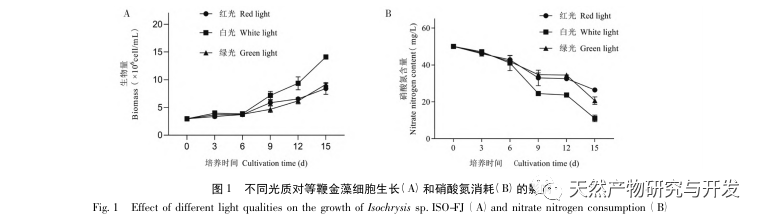
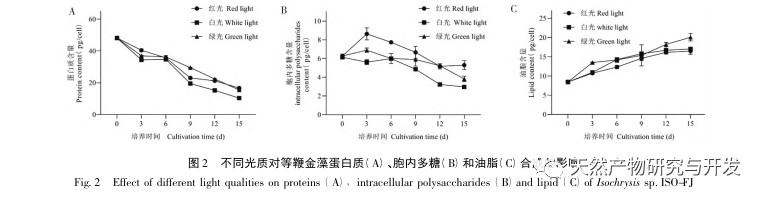
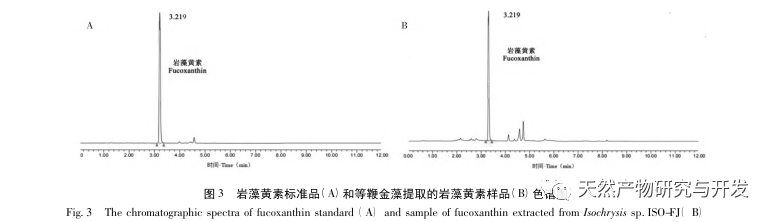
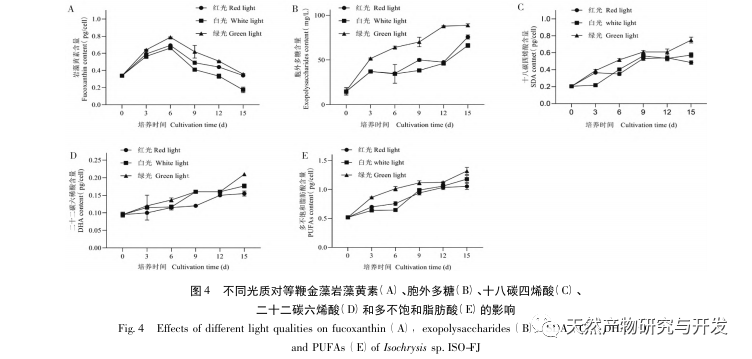
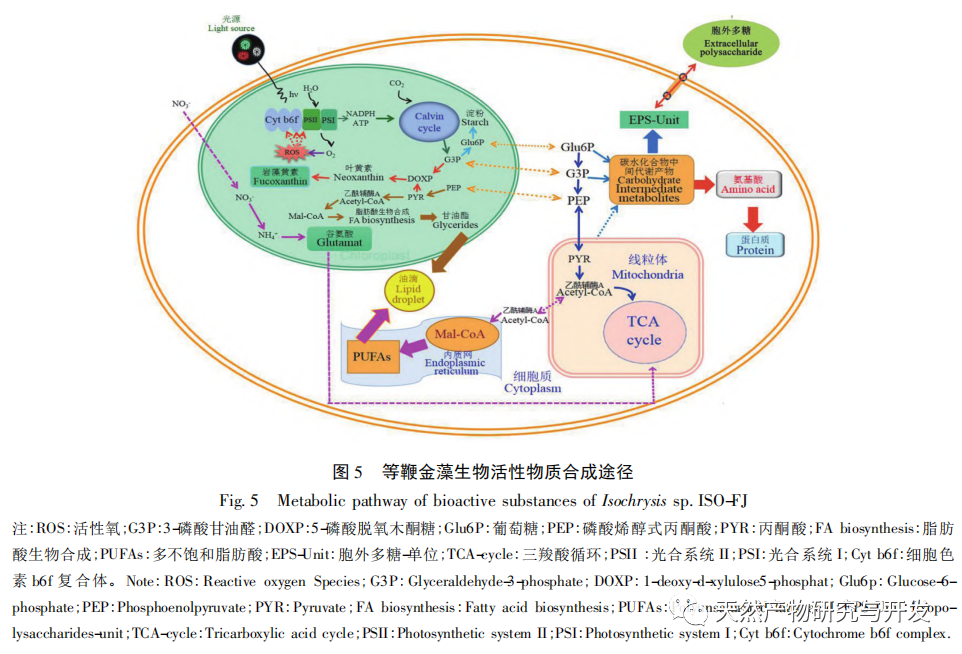
This experiment investigated the effects of three different light qualities, namely white light (400-700nm), red light (620-650nm), and green light (500-580nm), on the growth and accumulation of bioactive products of Chlamydomonas reinhardtii. The experimental results showed that different light qualities would significantly affect the growth and synergistic synthesis of bioactive products of Isoflagellates. In terms of microalgae cell growth, compared with the red and green light groups, using white light culture to cultivate dinoflagellates is more conducive to the growth of algal cells and the absorption of nitrate nitrogen nutrients. In terms of the synthesis of bioactive substances, among the three selected light qualities, algal cells can synthesize the largest amounts of fucoxanthin, extracellular polysaccharides, and PUFAs under green light conditions. From this, it can be seen that white light can promote the growth of dinoflagellates, while green light is more conducive to the accumulation of bioactive substances. In the future, a two-step method (first using white light cultivation and then using green light cultivation) can be used to cultivate Isoflagellates and investigate whether it can significantly improve the cell growth and synthesis of bioactive substances in Isoflagellates, and promote the large-scale production of bioactive substances in Isoflagellates.

 English
  Danish
  German
  Hungarian
  French
  Russian
  Spanish
  Turkish