
Characterization of Lipase Inhibiting Active Components in Gougu Leaves by Thin Layer Chromatography Bioautography MSn Method
Ilex cornuta Lindl Ex Paxt is a plant of the genus Ilex in the family Ilex, widely distributed in China. The dried leaves of Gougu, a traditional Chinese medicine, have been included in many herbal monographs since the Tang Dynasty and have a medicinal history of over a thousand years. According to the Pharmacopoeia of the People’s Republic of China (2020 edition, Volume 1), the taste of Ligusticum barbarum leaves is bitter, with a cool nature. It belongs to the liver and kidney meridians and has the functions of clearing heat and nourishing yin, benefiting the kidneys, and calming the liver. It is used for tuberculosis hemoptysis, bone steaming and hot flashes, dizziness and vertigo, etc. In folk culture, due to the heat clearing effect of Gougu leaves, their tender leaves are brewed and consumed as Kuding tea. Modern research has shown that the leaves of Cornus officinalis are rich in triterpenoids and their saponins, which are its main active ingredients. In addition, there are various components such as flavonoids, polyphenols, sterols, etc., which have various activities such as lowering blood lipids, anti myocardial ischemia, antioxidation, immunosuppression, and anti fertility. Due to the insignificant efficacy and significant side effects of most weight loss drugs, the lipid-lowering activity of Ligusticum barbarum leaves has gradually attracted people’s attention. Scholars at home and abroad have conducted extensive research on the chemical components of Ligusticum barbarum leaves, but traditional chemical separation methods have been used to search for lipid-lowering active ingredients, which have drawbacks such as time-consuming, complex operation, and loss of active ingredients.
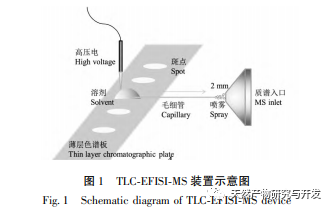
Thin layer chromatography bioluminescence is a drug screening technique that integrates identification, separation, and activity determination. In the past 20 years, it has been widely used for rapid screening of antioxidants, cholinesterase inhibitors, and lipase inhibitors. At the same time, this method has the characteristics of simple operation and low experimental cost. Direct ionization technology refers to a novel ionization technique used for rapid mass spectrometry analysis of complex matrix samples without pretreatment at atmospheric pressure. Thin layer chromatography coupled with electrostatic field induced spray ionization multi-stage mass spectrometry (TLC-EFISI-MSn) can realize the in-situ structural characterization of active components in the thin layer autoradiography of Lycium barbarum leaves. This direct ionization technology can extract compounds on thin layer chromatography plates through microdroplet extraction without additional gas and heating devices, and ionize them directly under the action of an electrostatic field before entering the mass spectrometer for analysis; It is an ionization method that is easy to disassemble, operate, and detect quickly. Therefore, this article adopts the method of thin-layer chromatography biological autoradiography mass spectrometry to quickly identify the components with lipid-lowering activity from the leaves of Ligustrum lucidum, providing a basis for clarifying the substance basis of the lipid-lowering effect of Ligustrum lucidum leaves.
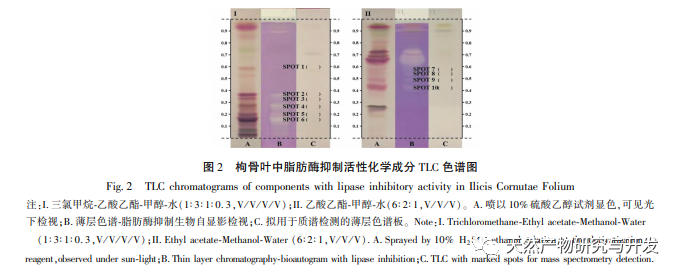
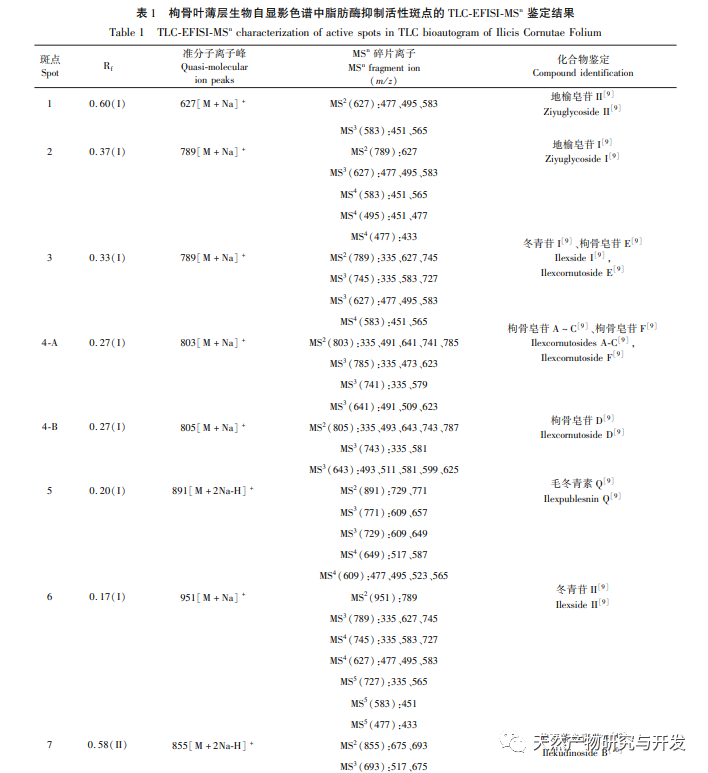
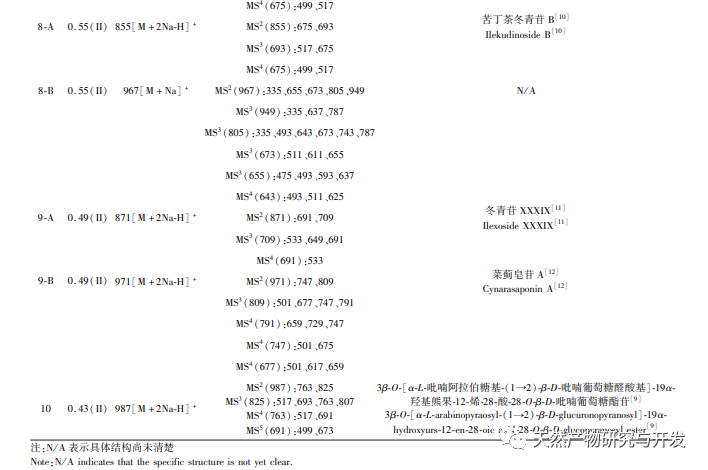
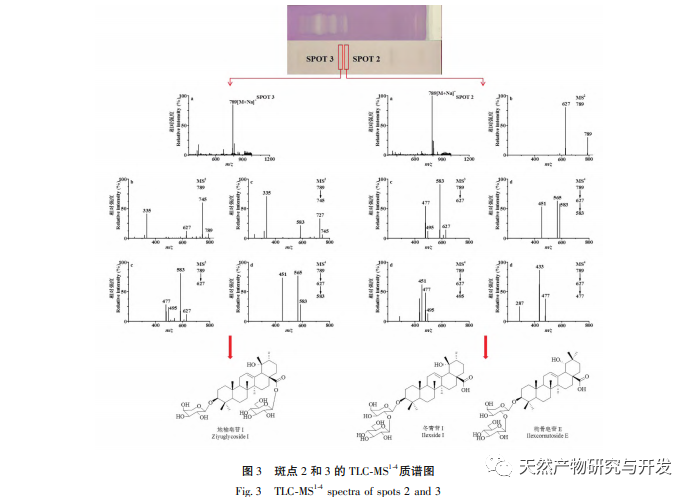
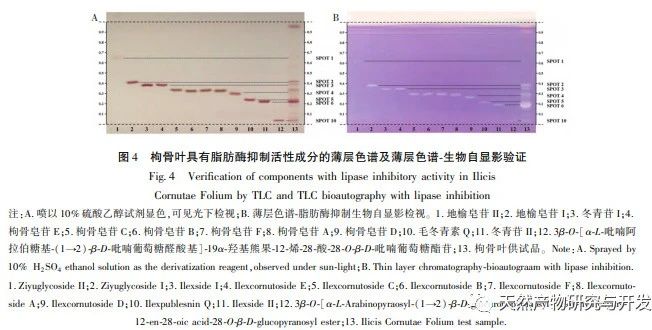
This article first developed the test sample of Ligustrum lucidum leaves in two systems: chloroform ethyl acetate methanol water (1:3:1:0.3, V/V/V/V) and ethyl acetate methanol water (6:2:1, V/V/V) to obtain more spots. Through thin-layer chromatography lipase inhibition bioluminescence examination, 10 spots with lipase inhibition activity in Ligustrum lucidum leaves were screened, and then the TLC EFISI MSn technology was used for rapid structural analysis of the above spots. Based on multi-stage mass spectrometry data combined with literature reports, possible fragmentation pathways of different compounds were speculated, and 15 possible structures were preliminarily characterized, all of which are triterpenoid saponins, including 9 arbutin triterpenoids, 1 oleanane triterpenoid, and 5 18,19-ring triterpenoids. After comparison with the reference substance, 12 compounds were validated. This method can quickly screen and characterize components with lipase inhibitory activity from the leaves of Cornus officinalis, providing a basis for clarifying the substance basis of lipid-lowering efficacy of Cornus officinalis leaves.
 English
  Danish
  German
  Hungarian
  French
  Russian
  Spanish
  Turkish