
Simultaneous determination of five flavonoid components in different types of mulberry branches using UPLC method
Mulberry branches, also known as mulberry strips, are the Morus alba L. and Morus alba M. plants in the mulberry family Australis Poir. and Huasan M Dry tender branches of cathayana Hemsl. Mulberry branches have a flat nature, a slightly bitter taste, and belong to the liver meridian. They are a traditional Chinese medicinal herb that has the effects of dispelling wind and dampness, promoting joint health, and mainly used to treat symptoms such as rheumatism, paralysis, and joint numbness and soreness in the arms and shoulders. Ancient books have recorded that mulberry branches can “treat dry mouth, nourish body fluids, and nourish kidney water”, and have the therapeutic effects of drying dampness, promoting blood circulation, and meridian circulation. They have a long history of clinical application in traditional Chinese medicine in China. Mulberry branches contain various effective active ingredients, such as flavonoids, alkaloids, amino acids, etc. According to modern pharmacological research, mulberry branches have multiple effects, including anti-inflammatory, antioxidant, hypoglycemic, lipid-lowering, hypotensive, antibacterial, antiviral, and anti-tumor. Mulberry branch flavonoids have good effects on lowering blood lipids, lowering blood sugar, as well as antibacterial and antioxidant properties.
This study used 18 batches of mulberry branches from 9 different production areas and 3 different types in Chongqing as experimental samples. Ultrasonic extraction was performed, and ultra performance liquid chromatography (UPLC) was used to determine and analyze the content of five flavonoids, including rutin, mulberry pigment, kaempferol, isoquercitrin, and mulberry quercetin, in these 18 batches of mulberry branches from 9 different production areas and 3 different types. The differences in flavonoid content among the 18 batches of mulberry branches were compared, providing data support and reference for subsequent mulberry branch research and development.
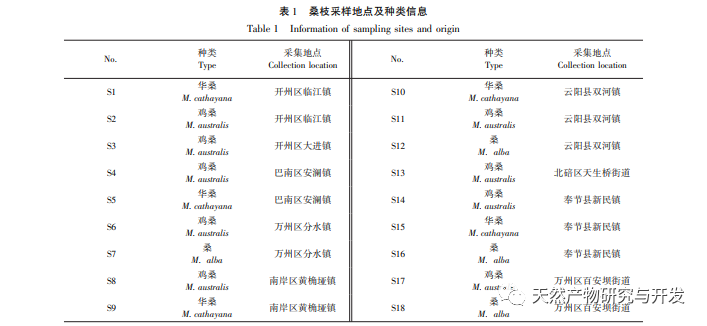
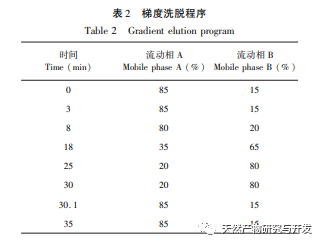
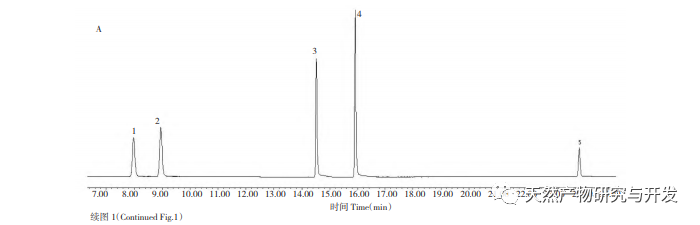
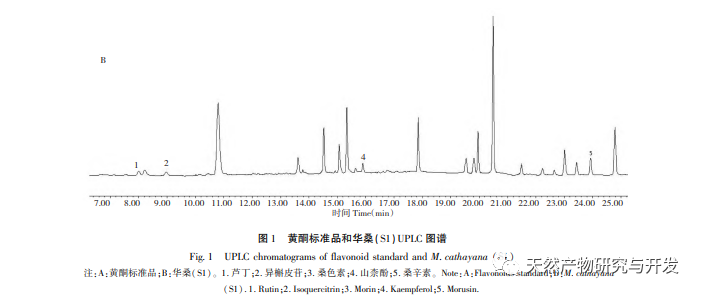
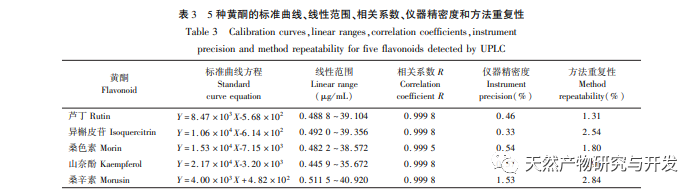
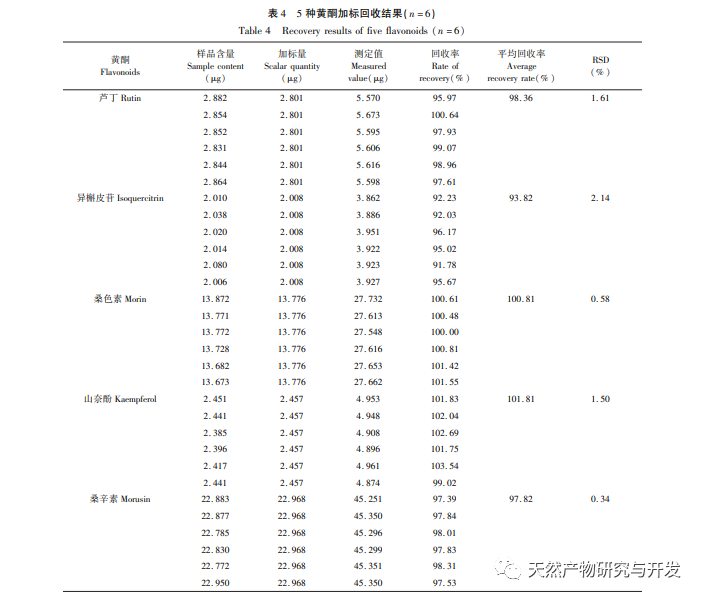
Selection of extraction conditions. This study investigated the methanol heating reflux extraction method, methanol ultrasonic extraction method, ethanol heating reflux extraction method, and ethanol ultrasonic extraction method. It was found that using methanol as the extraction solvent had better results. The extraction effects of heating reflux extraction method and ultrasonic extraction method were not significantly different. Considering the simple operation of ultrasonic extraction method, methanol ultrasonic extraction method was selected in this study. This study simultaneously considered the effects of extraction temperature, extraction time, and extraction times on the extraction efficiency. The final experimental results showed that the overall extraction effect was optimal when the extraction temperature was 25 ℃, extraction time was 30 minutes, and extraction times were 2 times. Therefore, the final extraction conditions of this experiment were determined to be using methanol solution and ultrasonic extraction method, with extraction temperature of 25 ℃, extraction time of 30 minutes, and extraction times of 2 times.
Selection of mobile phase. This study investigated the differences in the effects of four mobile phase compositions (0.2% formic acid solution+methanol, 0.2% formic acid solution+acetonitrile, 0.2% phosphoric acid solution+methanol, 0.2% phosphoric acid solution+acetonitrile) on peak formation. The experimental results showed that when the mobile phase was 0.2% formic acid solution+methanol and 0.2% phosphoric acid solution+methanol, the peak formation time was later and the analysis time was longer, especially for quercetin. When the mobile phase was methanol, the peak formation time was later, which affected the overall analysis time. When the mobile phase was 0.2% phosphoric acid solution+acetonitrile, the analysis time was shorter, the peak shape and separation effect were better. Therefore, this study chose 0.2% phosphoric acid solution+acetonitrile as the mobile phase. At the same time, the influence of different column temperatures (30, 35, 40 ℃) on the experimental results was also investigated. The experimental results showed that the separation effect was optimal when the column temperature was 35 ℃.
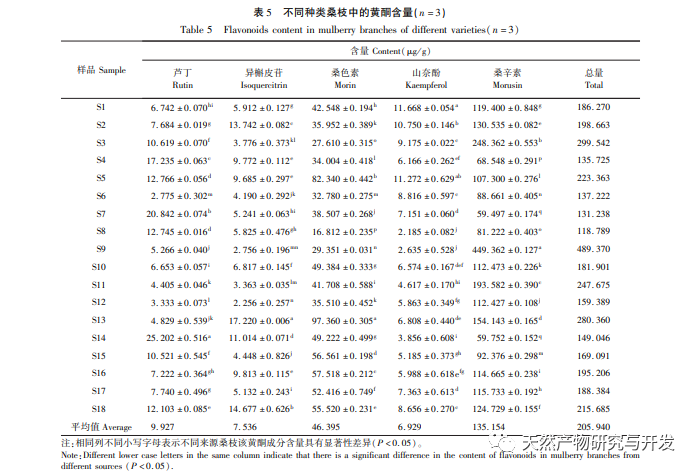
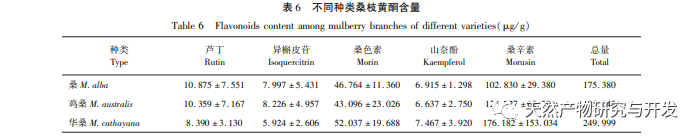
The content of flavonoids in mulberry branches. The research results showed that rutin, isoquercitrin, mulberry pigment, kaempferol, and kaempferol were detected in all 18 batches of mulberry branch samples, but there were significant differences in their content. The average content of kaempferol with the highest content was 135.154 μ g/g, and the average content of kaempferol with the lowest content was 6.929 μ g/g. This suggests that mulberry branches (especially Huasang in Huangjueya Town, Nan’an District) can be used as a source material for extracting kaempferol and further developing and utilizing it. The content of these five flavonoids in mulberry branches is influenced by various factors, such as the harvesting time of the branches, the type of mulberry tree, the parts of the branches (front, middle, and back), the origin of the branches, and so on. Sangxinsu has anti AIDS virus and anti-tumor effects. Mulberry pigments and isoquercitrin both have antioxidant activity and can scavenge DPPH free radical activity. Rutin can enhance the elasticity of capillaries, protect various tissues and organs, and induce cell apoptosis. Kaempferol has a good inhibitory effect on cancer cells. Like rutin, it induces apoptosis during the process of cell death and has anti-cancer effects. In summary, mulberry extract, mulberry pigment, isoquercitrin, rutin, and kaempferol all have good medicinal value and are of great significance for clinical medicine. Mulberry tree resources have a wide planting area in the Three Gorges Reservoir area, are easy to obtain, and have low raw material acquisition costs. Using mulberry branches as raw materials to extract flavonoids such as quercetin, mulberry pigment, isoquercitrin, rutin, and kaempferol will be a new trend for further development and utilization of mulberry branches.
 English
  Danish
  German
  Hungarian
  French
  Russian
  Spanish
  Turkish