
National Announcement
On October 21, 2010, the Ministry of Health (MOH) issued the Announcement on the Approval of 3 Items of Sucrose Polyester, Corn Oligopeptide Powder and Phosphatidylserine as New Resource Foods (MOH Announcement No. 15 of 2010), formally approving Sucrose Polyester as a new resource food.
On November 12, 2012, the Ministry of Health issued the Announcement on the Approval of 4 New Resource Foods, Including Protein Nucleated Chlorella (Ministry of Health Announcement No. 19 of 2012) to change the serving size of Sucrose Polyester, as described below:
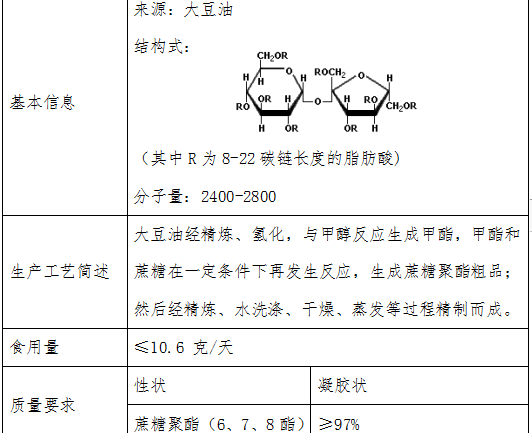
Characteristics of sucrose polyester
1. High stability
When subjected to repeated frying or high-temperature treatment, sucrose polyester maintains good quality, and there is no significant change in acid value, peroxide value and other indicators.
2. Non-absorbable
This is also an important factor as a fat substitute, but sucrose polyester is not fat after all, we can’t taste it, but the digestive tract enzymes can distinguish it. Digestive lipase does not recognize sucralose polyester, so it cannot be digested.
As a result, the stuff leaves the digestive tract intact, what you eat in, what you excrete out. But fat-soluble vitamins, such as vitamins A, D, E, and K, and nutrients like carotenoids and lycopene, are soluble in sucrose polyester.
Sucrose polyester can not be digested, but also these dissolved into the nutrients together out of the body, a waste of these nutrients;
3. Reduces energy
Since sucrose polyester can neither be digested nor absorbed, it can be discharged directly from the digestive system, so it can reduce the body’s energy intake and prevent obesity diseases.
4.Lower cholesterol
Research shows that cholesterol in ordinary fats and that sucrose polyester dissolution equilibrium constants are similar, dissolved in sucrose polyester cholesterol due to the non-absorption of sucrose polyester is not absorbed by the human body, thus reducing the rate of cholesterol absorption.
5. Low solid fat content in sucrose polyester
Defects in crystallization, these problems hinder its application in the processing of food-specific fats and oils.
Application of sucrose polyester in food processing
1. As a substitute of oil for fried food processing
For deep-fried food oil, it is required to have high oxidative stability, be able to withstand high temperature, and be able to withstand repeated heating without deepening of color, precipitation of impurities and decomposition of off-flavor substances. Palm oil, which is widely used today, is popular due to its unique fatty acid composition, high smoke point, and light color after frying.
Similarly, synthetic sucrose polyesters can be prepared with different physical and chemical properties by purposefully adjusting the distribution of fatty acyl groups in the molecular structure, where the ratio of fatty acid composition can be precisely controlled.
Choose products with high content of saturated fatty acids such as stearic acid and palmitic acid, which have very strong antioxidant ability, and at the same time, control its polymerization degree appropriately to maintain a suitable HLB value, so that the food to be fried has a strong goose penetration, which can be immersed into the interior of the food to ensure a good deep-frying effect. Neither produce unpleasant odor, also do not need to add antioxidants, can be mixed with other oils, can also be used alone.
Due to its characteristic of not being digested and absorbed by the human body, it can greatly reduce the excessive energy ingested into the body by consuming fried food and improve the quality of fried food. So that consumers do not have to worry about excessive fat intake and body fat when they taste the beautiful flavor of fried food.
2. As a substitute for shortening
The fat polyester with iodine value around 40-50 is in the form of gel, and as the iodine value further decreases, the viscosity gradually increases and becomes a plastic solid.
This characteristic of sucrose polyester makes it easy to be used in shortening as a substitute for hydrogenated oils and hard fats, which produces fine needle-like crystals and smooth texture in the shortening, and has an aerated cream-like character, which is especially suitable for making cakes and frostings.
Moreover, it is also a kind of pourable shortening, which can be pumped conveniently, providing great convenience for food processing operations.
3. As a fat substitute for margarine
Sucrose polyester with high stearic acid content has a strong plasticity with a melting point of about 31-33℃. Its expansion curve shows a gently rising shape in the range of 20-40℃. Very similar to traditional margarine, it is odorless and tasteless and can remain stable for a long time. The addition of suitable flavorings can give Cane Sugar Polyester products the same light aroma as cream.

 English
  Danish
  German
  Hungarian
  French
  Russian
  Spanish
  Turkish