
Edible enzymes originally originated in Japan and refer to edible products made by fermenting fruits, vegetables, grains and edible herbs with specific strains of bacteria and specific processes. Edible enzymes are rich in lipase, amylase, superoxide dismutase, lactic acid, acetic acid and a small amount of ethanol and other metabolites and phenols, flavonoids and other biologically active ingredients, with the elimination of free radicals, antioxidant, anti-bacterial, antioxidant, liver, laxative, immune regulator, metabolism and purification of blood and other physiological functions.
Based on the R&D experience of enzymes in Japan and Taiwan, in recent years, domestic organizations have mainly focused on the fermentation mechanism, nutritional mechanism, industry standardization and development and application of edible enzymes to carry out research, and have independently researched and developed edible enzymes with rich varieties, diverse functions, and broad market prospects, which have shown a sustained growth of a good development trend.
Types of edible enzymes
According to the Guidelines for Classification of Enzyme Products (T/CBFIA08001-2016) issued by China Biofermentation Industry Association in 2016, edible enzyme refers to the enzyme products containing specific bioactive ingredients that can be consumed by human beings, which are made from raw materials such as animals, plants, edible fungi, etc., with or without the addition of auxiliary materials, and are produced by microbial fermentation. They can be divided into 3 categories according to their functions:
① to promote the body’s nutrient metabolism of metabolic enzymes, such as glycolysis in favor of hexokinase, pyruvate kinase, 6-phosphofructokinase, etc. are metabolic enzymes.
② decomposition or hydrolysis of nutrients digestive enzymes, such as catalyzing the hydrolysis of starch into maltose salivary α-amylase and can cut off the carboxyl side of lysine and arginine residues in the polypeptide chain of tryptic protein enzymes are digestive enzymes.
(iii) Food-type enzymes that are beneficial to the human body come from raw food, and such enzymes include papain enzyme, pineapple enzyme, aloe vera enzyme, and various fruits and vegetables enzymes.
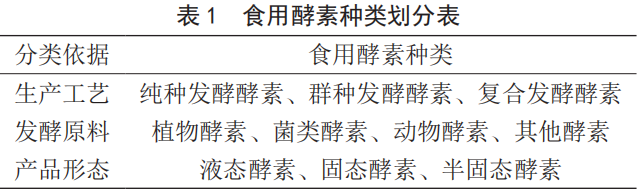
The division of food enzymes is shown in Table 1.
Applied research on enzymes
1. Edible enzyme functional health food or enzyme medical food
Qian Shiliang has developed a health care edible mushroom liquid enzyme processed with edible mushrooms (the amount of purple ganoderma lucidum added is 12%-15%, the amount of Cordyceps added is 12%-15%, and 70%-76% of the components are made from a combination of natural nutrients contained in the mycelium, fruiting bodies, or spores of wild or artificially cultivated edible mushrooms), which can, to varying degrees, improve the symptoms of fatigue, drowsiness, a little bit poor appetite, and insomnia of the middle-aged and elderly people. Insomnia and other symptoms, suitable for middle-aged and elderly patients with chronic diseases and tumors during the treatment and rehabilitation period of health care and physical conditioning.
Li Cuihong used bitter melon, cucumber and pumpkin, kelp root, kudzu root and motherwort as raw materials, respectively, after enzymolysis and fermentation, and then through fermentation, storage, filtration and blending to get a kind of edible enzymes for people with high blood glucose, which can effectively release the active ingredients of traditional Chinese medicine, enhance the function of gastrointestinal and immunity, and have significant effect on lowering blood glucose.
Jiang Zhongli developed brown rice Eco Enzyme Red Currant Wine, in which the optimal raw material ratio of rice:brown rice Eco Enzyme is 3:1, the optimal amount of red currant is 10%, the optimal amount of yeast is 1.0%, and the optimal ratio of raw material to water is 1:1.5, and the fermentation was carried out for 8d at 24~28 ℃.
2. Eco-enzyme meal replacement powder
Yanjun Feng developed a barley seedling enzyme product by fermentation of yeast and lactic acid bacteria with barley seedling as the main raw material, and made it into enzyme powder by spray drying and added it into meal replacement powder to improve the added value of the product. Yanjun Feng et al. found that the total phenol release from digestive fluid after 4 h of in vitro gastric digestion of the wheat seedling enzyme powder and its meal replacement powder was 2.74 times and 2.75 times of that of the initial time, respectively. SOD activity decreased by 45.54% and 38.99%, and the antioxidant function was significantly improved; the indexes did not change much when the intestinal digestion was more than 4h. In the process of in vitro digestion, the increase of total phenol release does not compensate for the inactivation of SOD, so that the antioxidant property of digestive fluid is obviously improved, indicating that the consumption of wheat seedling enzyme powder and its meal replacement powder is beneficial to the antioxidant function of the human body.
The Institute of Agricultural Products Processing of Shanxi Academy of Agricultural Sciences mixed sea buckthorn enzyme powder prepared by fermentation of sea buckthorn pulp, enzyme bacteria, apple juice concentrate and oligofructose with quinoa flour, oatmeal whole flour, gluten and maltodextrin, and then obtained a kind of high-fiber enzyme composite omnivorous flakes by extrusion puffer puffing and forming and after roasting and cooling.

 English
  Danish
  German
  Hungarian
  French
  Russian
  Spanish
  Turkish