
Research progress on natural active ingredients for anti Alzheimer’s disease based on target mechanism
Alzheimer’s disease (AD) is a degenerative neurological disorder that is more common in the elderly population aged 65 and above. Early clinical manifestations of AD include short-term memory impairment, which gradually worsens and is accompanied by multiple functional impairments such as language, cognition, orientation, and judgment, seriously affecting patients’ daily living abilities and even endangering their lives. According to the 2021 World AD Report released by the International AD Association, there are approximately 55 million dementia patients worldwide, with an estimated 10 million new cases per year. Dementia caused by AD accounts for about 64% of dementia cases. There are nearly 10 million AD patients in China, making it the country with the highest number of patients in the world, and it is expected to exceed 40 million by 2050. With the acceleration of global population aging, AD has become not only an important public health issue, but also a serious social problem.
The onset of AD is insidious and the progression of the disease is irreversible. Currently, AD drugs used in clinical practice can only delay the disease progression, cannot reverse the condition, and have a certain degree of side effects. The development of highly efficient and low toxicity anti AD drugs remains a serious challenge for the global pharmaceutical industry. The pathological features of AD mainly include extracellular senile plaques with β – amyloid (A β) as the core formed in the cerebral cortex and hippocampus, neurofibrillary tangles (NFTs) with abnormal phosphorylation of tau protein as the core, and neuronal loss. However, to this day, the pathogenesis of AD is not fully understood. Based on the pathological characteristics of AD, it mainly includes various theories such as A β theory, tau protein theory, cholinergic injury theory, immune inflammation theory, and gut microbiota, indicating that the pathogenesis of AD is complex and the occurrence and development involve multiple mechanisms. The drug development strategy based on different mechanism targets has become the main research direction of current anti AD drugs.
Natural products contain a vast variety of active ingredients, with the characteristics and advantages of multi-component and multi-target effects, which are in line with the pathogenesis of neurodegenerative diseases with multiple factors and pathological mechanisms of AD. With the continuous optimization of modern separation and identification technology, screening and discovering efficient, highly selective, and low toxicity targeted anti AD active ingredients from natural products is one of the important approaches for the development of anti AD drugs. This article is based on the current single target and multi-target screening strategies for AD drug development, combined with various targets involved in the pathogenesis of AD, to review and summarize the anti AD active ingredients discovered in natural products in recent years, in order to provide reference for the development of efficient anti AD drugs.
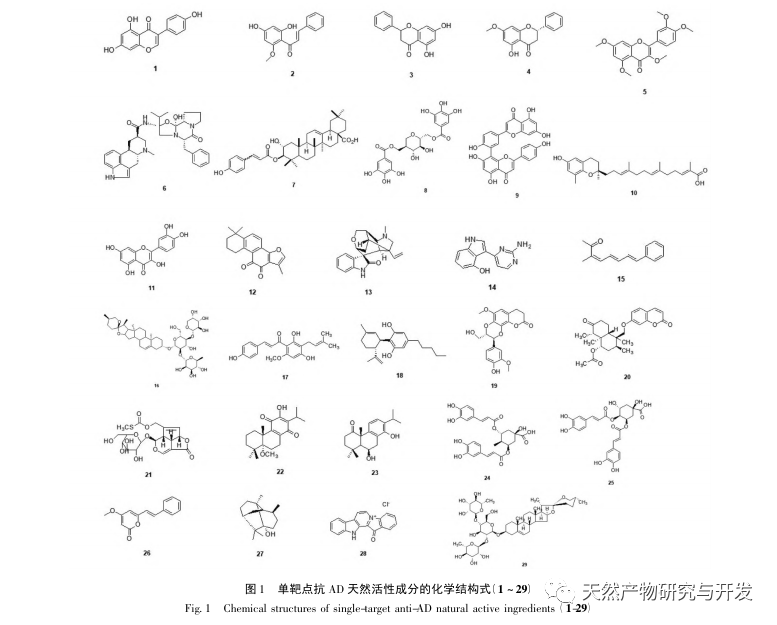
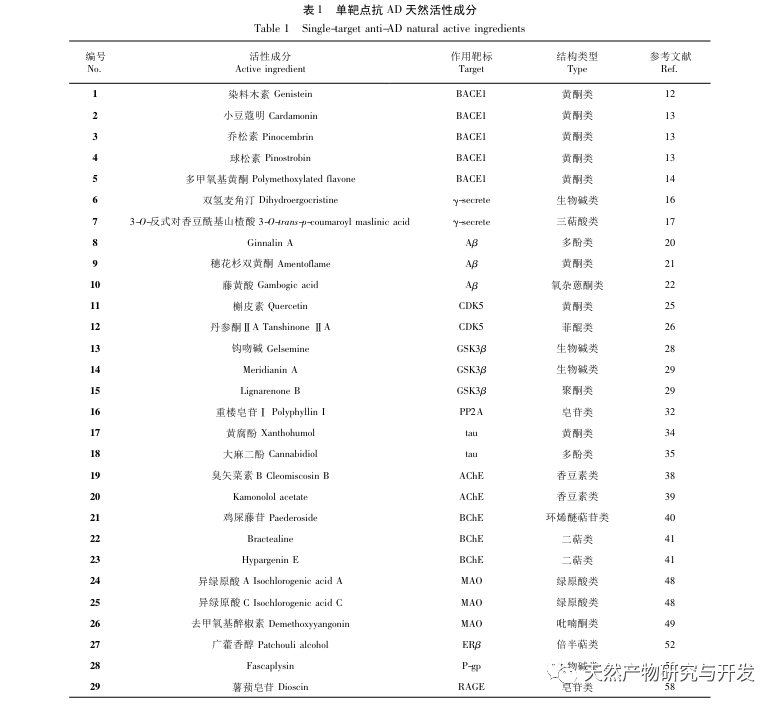
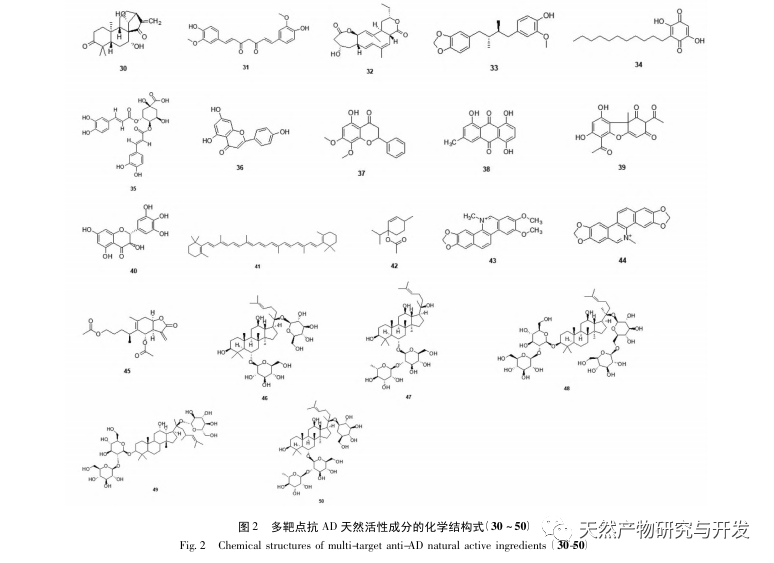
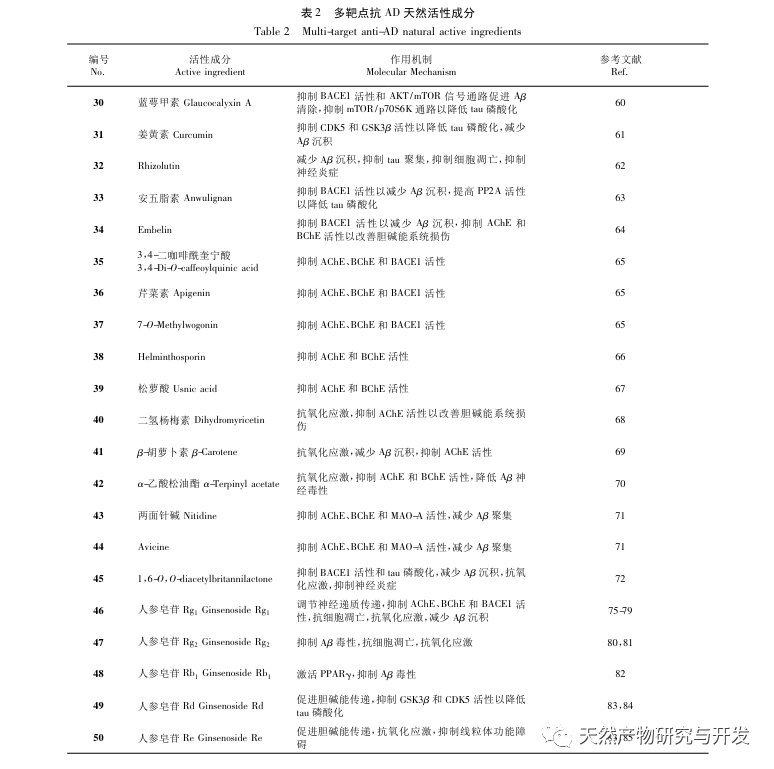
Natural products have diverse types and broad pharmacological activities, and have always been an important source of new drug development. The high failure rate of current AD candidate drug clinical trials serves as a warning that we need to face difficulties and challenges in screening potential active ingredients for anti AD drugs. Analyzing the current situation, there are still some problems in the screening and clinical application of natural anti AD active ingredients. Firstly, with the exponential increase in the number of discovered active ingredients, traditional high-throughput screening methods are no longer sufficient to meet the needs of new drug development. In recent years, new virtual screening technologies based on artificial intelligence such as molecular similarity methods, machine learning, and deep learning have provided new avenues for the discovery of natural product lead compounds due to their significant advantages of high efficiency and low cost. Therefore, the combination of virtual screening technology and experimental verification will accelerate the discovery cycle of natural products as new chemical frameworks or active precursors for anti AD drugs. Secondly, current AD animal models cannot fully simulate all pathological features of AD. We need to better understand the characteristics and limitations of each model, use multiple models to comprehensively evaluate the therapeutic effect of natural products on AD, and clarify their targets and molecular mechanisms of action. Again, some natural anti AD active ingredients have problems such as low bioavailability and difficulty in crossing the blood-brain barrier. Further structural modification and optimization are needed, or dosage form modification and combination therapy methods should be adopted to improve the selectivity of targets and anti AD efficacy. Finally, in addition to plant-based natural products, natural products from marine and fungal sources also provide new sources for the development of anti AD drugs.
I believe that with the continuous exploration of the pathogenesis of AD in the medical field, the continuous development and progress of modern analytical techniques, targeted screening methods, computer-aided drug design, and artificial intelligence technology, significant progress will be made in developing anti AD drugs from natural products.

 English
  Danish
  German
  Hungarian
  French
  Russian
  Spanish
  Turkish