
Preliminary study on the protective mechanism of turnip neutral polysaccharides against oxidative damage in PC12 cells
Turnip (Brassica rapa L.), also known as Chagu or Manjing, belongs to the Brassicaceae family and the Brassica genus. It is used as a medicinal herb with its roots and is rich in nutrients. It can be consumed for a long time and is known as the “longevity fruit”. It has the effects of appetizing and digestive, promoting qi circulation, relieving cough and asthma, promoting diuresis and detoxification. Modern pharmacological research has found that turnips have pharmacological activities such as lowering blood sugar, antioxidation, anti-aging, anti-tumor, regulating immunity, and anti-inflammatory. In the preliminary research, the research team measured that the content of turnip polysaccharides was about 11.53%. After defatting and decolorizing purification, the water-soluble turnip polysaccharide BRP was obtained. It was further isolated and purified to obtain neutral polysaccharides from Brassica rapa L. (BRNP) and acidic polysaccharides from Brassica rapa L. (BRAP), and their structures have been identified. Preliminary experiments have shown that turnip polysaccharides have good antioxidant activity, which lays the experimental foundation for the application of turnip polysaccharides in antioxidant and anti-aging research. Therefore, this study established a premature aging model of PC12 cells induced by H2O2 to investigate the expression levels of Bax, Bcl-2, and Caspase-3 proteins in PC12 cells after H2O2 induced injury by BRNP, and further elucidate the anti-aging mechanism of BRNP.
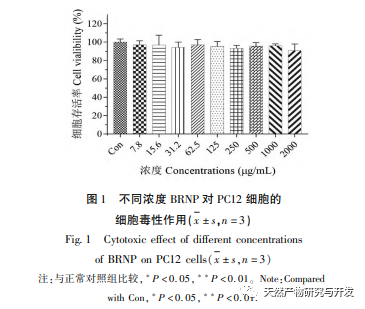

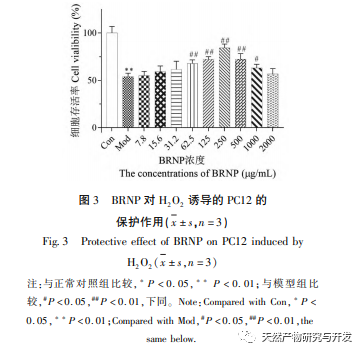
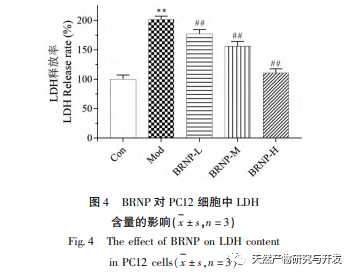
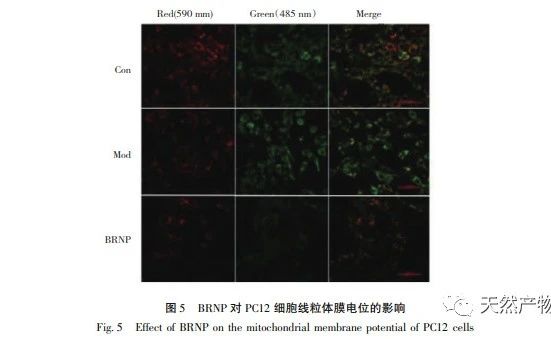
H2O2 is an reactive oxygen species molecule that can increase the intracellular reactive oxygen species content and cause damage to cells. It is widely used to obtain cell aging models in a short period of time. Cell proliferation activity is an important indicator for determining whether cultured cells can proliferate normally under specific conditions. The CCK-8 experiment results showed that the survival rate of PC12 cells significantly decreased with the increase of H2O2 concentration, and exhibited a dose-dependent effect. When treated with 300 μ mol/L H2O2 for 4 hours, the cell survival rate was 60.64%. At this time, PC12 cells were damaged to a certain extent, but had not yet reached an irreversible state. Therefore, 300 μ mol/L was selected as the optimal concentration and time for oxidative damage in PC12 cells for 4 hours in subsequent experiments.
To verify whether BRNP has cytotoxic effects on PC12 cells, BRNP was used alone to treat PC12 cells without H2O2 damage. The experimental results showed that there was no significant change in the survival rate of PC12 cells after treatment with different concentrations (7.8-2000 μ g/mL) of BRNP (P>0.05), indicating that BRNP had no significant cytotoxicity on PC12 cell viability. When studying the effect of BRNP on H2O2 induced damage in PC12 cells, the results showed that compared with the Model group, the cell survival rate gradually increased with the increase of BRNP concentration (P<0.05), and the cell survival rate significantly increased when the BRNP concentration reached 250 μ g/mL. Based on experimental results, BRNP has a certain protective effect on H2O2 induced damage in PC12 cells.
Lactate dehydrogenase (LDH) exists inside cells and can catalyze the production of lactate from pyruvate. When cells are damaged, LDH is released in large quantities, leading to a significant increase in extracellular LDH levels. The amount of LDH released is proportional to the degree of damage, so LDH leakage rate can reflect the degree of cell damage. The results of this experiment suggest that BRNP can prevent or slow down the degree of cell membrane damage and prevent the leakage of intracellular LDH.
The proton distribution on both sides of the inner membrane of mitochondria within the cell is not uniform, forming an electrochemical gradient known as mitochondrial membrane potential. Numerous studies have shown that when any apoptosis inducing factor stimulates cell apoptosis, a decrease in mitochondrial membrane potential occurs, and this decrease in membrane potential occurs earlier than changes in cell morphology. The significant decrease in mitochondrial membrane potential will lead to irreversible apoptosis of cells, therefore, the decrease in mitochondrial membrane potential can be regarded as a classic phenomenon in the early stage of cell apoptosis. At present, research has confirmed a close relationship between mitochondrial dysfunction and the aging process. For example, insufficient supply of mitochondrial energy (MMP and ATP) can reduce the body’s metabolic capacity, leading to a series of aging changes. Among them, the decrease in mitochondrial membrane potential is one of the specific markers of cell apoptosis. The research results showed that the mitochondrial membrane potential of PC12 cells was significantly reduced after H2O2 treatment, and BRNP pretreatment could prevent the membrane potential reduction caused by H2O2.
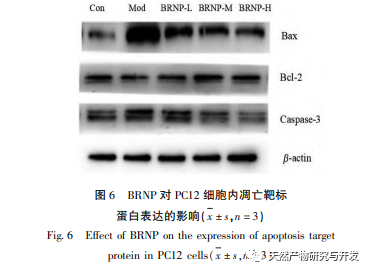
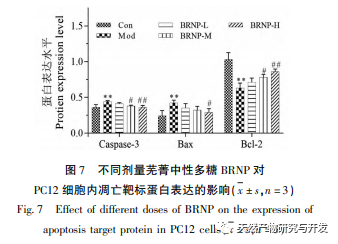
Apoptosis is a programmed cell death process that includes exogenous Fas/FasL mediated death receptor pathways, as well as endogenous mitochondrial and endoplasmic reticulum pathways. Among them, the mitochondrial mediated endogenous apoptosis pathway is the main pathway for programmed cell death in mammalian cells. Bax, represented by pro apoptotic proteins, and Bcl-2, represented by anti apoptotic proteins, are the main proteins regulating the release of mitochondrial apoptosis factors. Caspase protease is a key apoptosis effector in mammals, among which Caspase-3 is a key protease in the Caspase family that activates various apoptosis stimulating factors and is known as an important executor of cell apoptosis. BRNP reduces the expression of Caspase-3 to a certain extent in PC12 cells damaged by H2O2 oxidation. It can be speculated that BRNP may decrease the expression of Caspase-3, reduce cell apoptosis, and thus delay the aging of the body. After intervention with BRNP, the expression level of Bcl-2 increased in PC12 cells with oxidative damage, while the expression levels of Bax and BRNP decreased to varying degrees. These research results can indicate that BRNP assists cells in resisting oxidative stress damage to mitochondria and DNA, reduces cellular oxidative damage, and enhances the body’s ability to regulate antioxidant stress.
 English
  Danish
  German
  Hungarian
  French
  Russian
  Spanish
  Turkish