Changes in antioxidant synergy between purple sweet potato and carrot before and after processing
Purple sweet potato Ipomoes batatas (L.) Lam not only contains the components of ordinary sweet potatoes, but also is rich in various active ingredients such as anthocyanins, phenolic compounds, glycoproteins, carotenoids, etc. It has significant physiological effects such as antioxidant, anti-tumor, memory enhancement, prevention of hypertension, and enhancement of the body’s immune system. The phenolic hydroxyl structure of anthocyanins gives them good antioxidant activity, which can effectively inhibit ROS damage to the body. It also has significant effects in anti mutation and anti cardiovascular disease. Carrots (Daucus carota var. sativa Hoffm.) contain abundant carotenoids, which are a type of natural pigment widely found in plants. Carotenoids can participate in photosynthesis, give plants color, and have various biological activities. Some carotenoids have the same ring structure as vitamin A1 and can be converted into vitamin A in the body, making them a major pathway for the human body to obtain vitamin A. The isoprene structure of carotenoid molecules is the structural basis of their antioxidant activity, which enables them to clear free radicals, quench singlet oxygen, and inhibit low-density lipoprotein oxidation.
Research has shown that common antioxidant substances such as VC, VE, and β – carotene are not the main active ingredients that provide antioxidant capacity for daily diets. Therefore, it can be inferred that complex mixtures of other phytochemicals in the diet may have more positive antioxidant effects. Pan et al.’s research shows that by mixing hydrophilic and lipophilic extracts from different plant sources in different proportions, certain combinations of extracts exhibit stronger synergistic antioxidant effects than individual groups, effectively clearing excess free radicals in the body, enhancing antioxidant capacity, and having a positive effect on the inhibition of inflammation or the occurrence of chronic diseases in the body.
The main cooking methods for vegetables in China include stir frying, deep frying, boiling, steaming, etc. Among them, the oil content of stir frying and deep frying methods is generally high, while boiling and steaming methods can achieve low oil cooking. Different processing methods also have a certain impact on the phytochemicals contained in the diet. However, there are currently few reports on evaluating the phytochemicals and antioxidant activity of fruits and vegetables processed using different processing methods and compounded in different proportions. Relevant studies focus on the changes in phytochemical activity in fruits and vegetables before and after processing, and there are no reports on the compounding of processed fruit and vegetable extracts. This experiment treated purple sweet potatoes and carrots with different heat processing methods, and measured the content of phytochemicals in purple sweet potatoes and carrots before and after processing, as well as the in vitro antioxidant activity of extracts; Mix the extracts in different proportions and evaluate their antioxidant effects after compounding; By simulating digestion in vitro, the changes in phytochemical content and antioxidant activity at different stages of digestion were measured and analyzed, providing methods and ideas for exploring scientific dietary ratios.
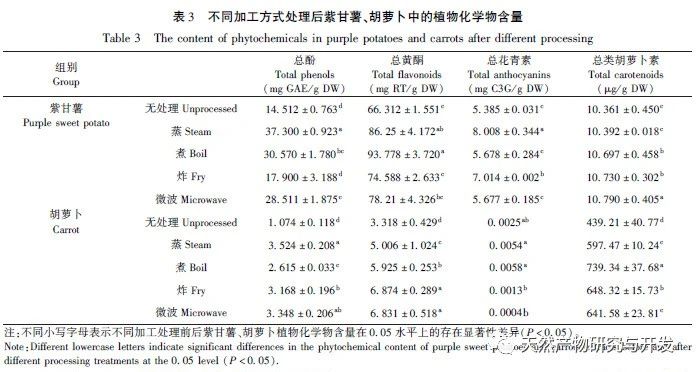
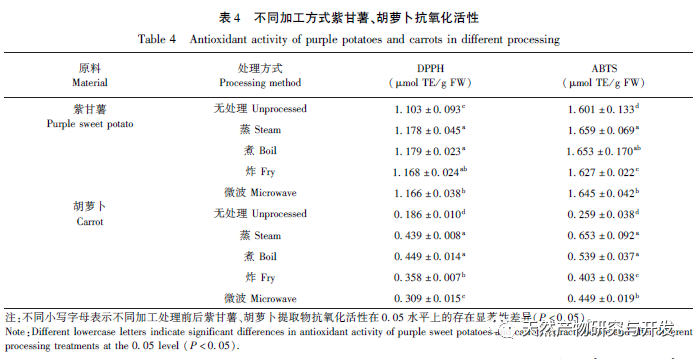
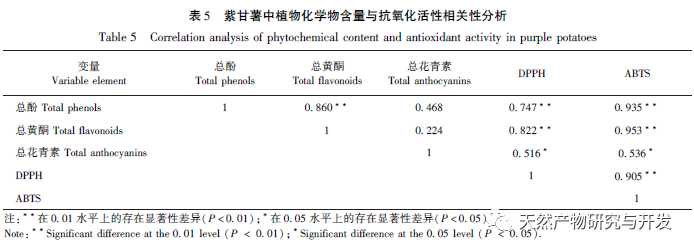
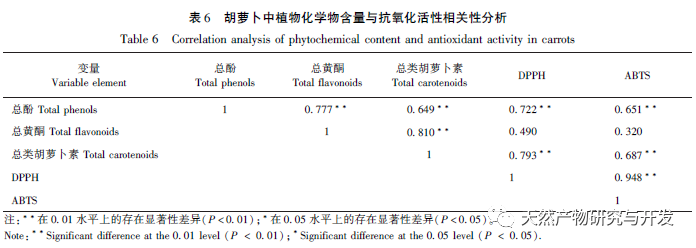
 Purple sweet potatoes and carrots were processed using four methods: steaming, boiling, frying, and microwaving, and the changes in total phenols, total flavonoids, total anthocyanins, and total carotenoids content before and after treatment were measured. The results showed that steaming and boiling processing can effectively convert the bound phytochemicals in purple sweet potatoes and carrots into free states for human absorption and utilization, and the degradation degree of phytochemicals caused by steaming and boiling processing is relatively low compared to frying and microwave processing. At the same time, DPPH and ABTS methods were used to determine the antioxidant activity of steamed, boiled, fried, microwave treated and untreated purple sweet potatoes and carrots. It was found that steamed and boiled processed purple sweet potatoes and carrots had better antioxidant activity compared to other processing methods. Correlation analysis also showed that total phenols, total anthocyanins, and total carotenoids showed good positive correlations with DPPH and ABTS, indicating a good positive correlation between plant chemical content and its antioxidant activity.
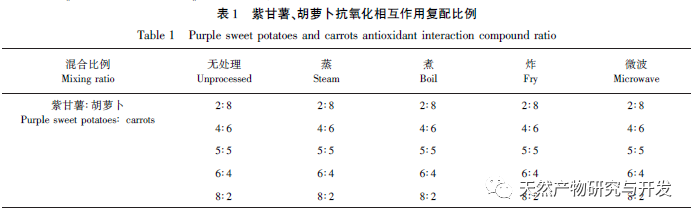
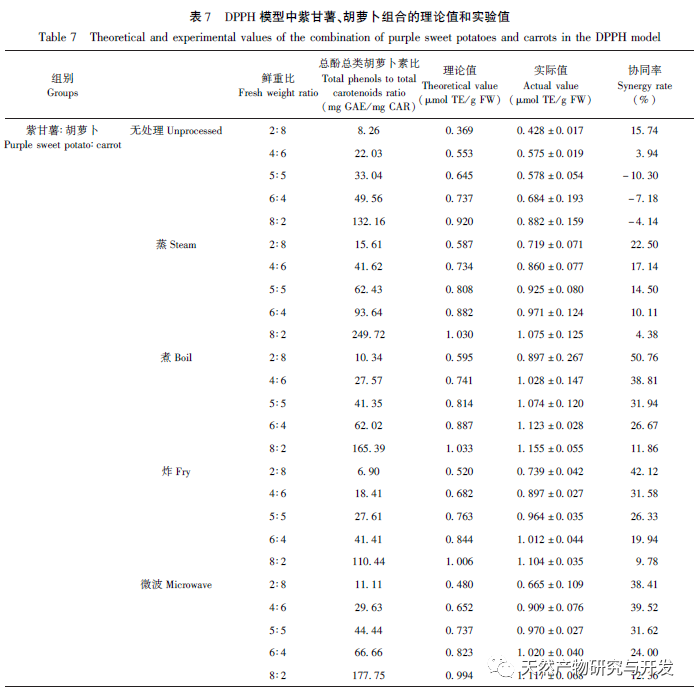
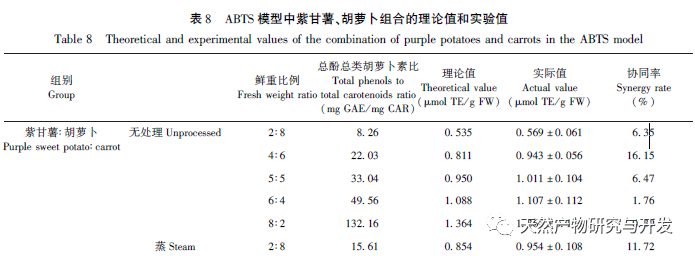
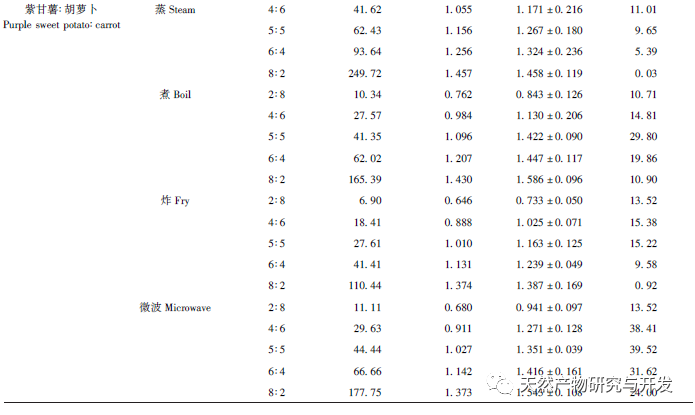
The purple sweet potato and carrot treated with the same method were compounded according to different fresh weight ratios, and the compounded combination showed significant antioxidant synergistic effects. In the DPPH group, when cooked and processed purple sweet potatoes were compounded with carrots in a ratio of 2:8, the synergistic rate reached its maximum (50.76%). In the ABTS group, the microwave 5:5 group had the highest antioxidant synergistic rate (39.52%), followed by the microwave 4:6 group (38.41%), while the steaming 8:2 group had the lowest antioxidant synergistic rate (0.03%). Overall, when the ratio of purple sweet potato to carrot is around 2:8 to 4:6 in terms of fresh weight, that is, when the carrot accounts for a larger mass, its antioxidant synergistic effect is the best. When the fresh weight ratio is converted to the content of water-soluble and fat soluble phytochemicals for the ratio, the overall antioxidant synergistic effect can be significantly demonstrated when the proportion of water-soluble phytochemicals is higher.
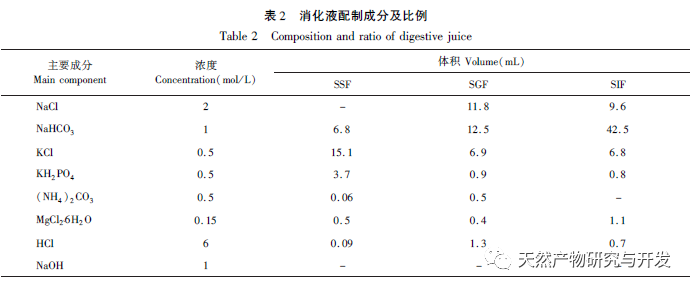
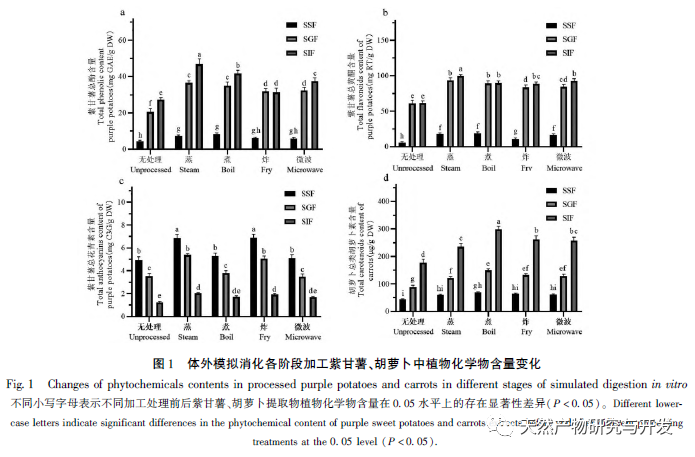
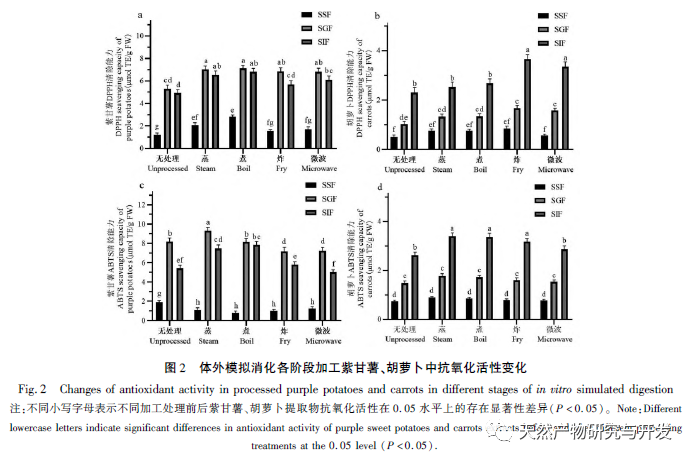
In vitro simulated digestion experiments were conducted on purple sweet potatoes and carrots that were steamed, boiled, fried, microwave-assisted, and untreated. The changes in total phenols, total flavonoids, total anthocyanins, total carotenoids content, and antioxidant capacity were measured at different stages. The total phenolic and flavonoid content of purple sweet potatoes processed by various methods showed the most significant increase trend during the gastric digestion stage, and the increase trend slowed down significantly during the intestinal digestion stage. The total anthocyanin content continued to decrease during the digestion process, and the DPPH and ABTS free radical scavenging ability showed a sequence of gastric digestion stage>intestinal digestion stage>oral digestion stage. The total carotenoid content of carrots processed by various methods continues to increase during the digestion process, and the growth trend in the intestinal digestion stage is greater than that in the gastric digestion stage. Its DPPH and ABTS free radical scavenging ability is consistent with the changes in total carotenoid content, manifested as intestinal digestion stage>gastric digestion stage>oral digestion stage.
 English
  Danish
  German
  Hungarian
  French
  Russian
  Spanish
  Turkish