
Markets
On April 25, 2021, the official website of the National Health Commission released the Announcement on Six “Three New Foods”, including β-1,3/α-1,3-Glucan (No. 5 of 2021), in which Micrococcus sp. is one of the approved new food ingredients, and it has become a new member of the family of new food ingredients of algal origin.
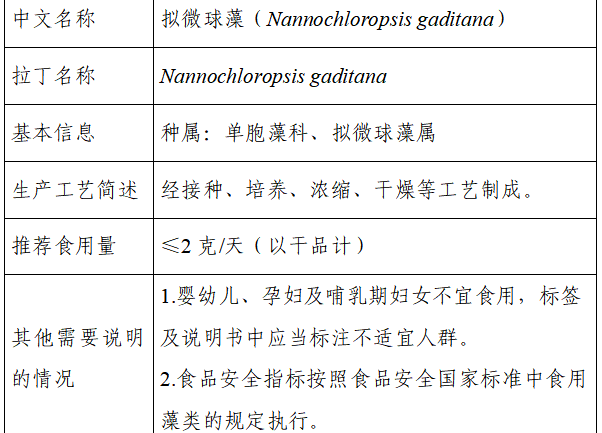
Nannochloropsisgaditana belongs to the genus Nannochloropsis in the family Monocotyledonaceae, and its body is tiny and usually green or yellowish green. Foods containing the algae are sold in the United States, Chile, Canada and other countries. The algae contains protein, eicosapentaenoic acid (EPA) and other nutrients, and its recommended serving size is ≤2 g/day (in dry form).
According to the provisions of the Food Safety Law and the Administrative Measures for the Review of the Safety of New Food Ingredients, the National Health and Wellness Commission commissioned the review body to organize experts to review and pass the safety assessment materials of proposed micrococcus (Nannochloropsisgaditana) in accordance with the statutory procedures.
The production and use of new food ingredients should be in line with the content of the announcement and the requirements of food safety-related regulations. In view of Nannochloropsisgaditana (Nannochloropsis) in infants and young children, pregnant women and lactating women in the population of food safety information is insufficient, from the principle of risk prevention considerations, the above groups of people should not be consumed, labeling and instructions should be marked unsuitable for the population.
The food safety index of this raw material is in accordance with the provisions of edible algae in China’s current national food safety standards.
Application of Microcystis aeruginosa
Microalgae can be collected and dried to obtain whole algal powder and defatted algal powder, which can be applied to a variety of common and tasty food through processing, and made into microalgae food.
Up to now, a variety of microalgae-related products have been successfully developed, such as microalgae active peptide drinks, microalgae meal replacement powder, microalgae energy bars, microalgae nutritional beverages, microalgae children’s noodles and dumplings, as well as bakery, plant-based meat, pressed confectionery, natural pigments, and algal snacks (crispy tablets, puffed, spicy strips, etc.), and so on.
International Microalgae Food Market Dynamics
According to the latest report published by Transparency Market Research, the global microalgae market is expected to grow at a CAGR of about 5% during 2020-2030, with a market value of US$3.2 billion by the end of 2030, and food and beverages are expected to be the major application areas for microalgae products.
Microalgae has gained popularity in the European and American markets by virtue of its high protein, high unsaturated fatty acid, and green nutritional characteristics, and a number of foreign food companies as well as launched microalgae-related food products, focusing on the concept of fresh and healthy consumption.
In 2020, Unilever announced its cooperation with Algenuity, a British biotechnology company, to try to develop plant-based products using microalgae raw materials. This is another food giant company betting on the microalgae field after Mars, Yizz, Nestle and Coca-Cola, laying out in advance for the future development of products related to microalgae.
From 2015 to 2017, Coca-Cola invested in Suja cold-pressed juice company targeting the “microalgae” market, launched four “microalgae” fruit and vegetable juices, including Green Delight (May 2015), Mighty Dozen Green Delight (May 2015), Mighty Dozen (January 2017), Easy Greens (December 2016) and Green Charge (April 2016), all of which are infused with chlorella and spirulina.
PepsiCo’s Naked Juice has also launched a line of microalgae drinks, fruit and vegetable shakes with chlorella and spirulina added.
B-Blue and Smart-Chimp, two French beverage companies, have launched functional algal blue protein beverages for sports people.
Sun Chlorella, a leading Japanese health food brand, has teamed up with Kyoto’s historic Ishimaru Noodles this year to develop a dark green chlorella Sanuki Udon.
Plant-based seafood company New Wave Foods has now raised $18 million in Series A funding to bring its products to market. Its first product, plant-based shrimp, is made primarily from sustainable seaweed and plant proteins. The product is said to taste very similar to shrimp and can be used in the same cooking methods as shrimp, such as stir-frying, deep-frying, grilling and more.
Sweet Spirulina Sprouted Bites from Go Raw are algae-containing snacks with ingredients such as sprouted sesame seeds, bananas, coconut (unsweetened), dates, and spirulina.Thomas Chipman’s new Organic Tortilla Chips have ingredients such as spirulina, kale, palm oil, and sea salt in addition to corn.
What are the prospects for the microalgae market in China?
In the 21st century, microalgae have gradually gained official approval from the state, and in 2004, Spirulina obtususus and Spirulina divaricata were approved for consumption as common foods. Subsequently, many algae were approved as new food ingredients.
With the vigorous development of microalgae biotechnology and the fundamental innovation of microalgae cultivation methods, China has become the world’s largest microalgae producer, with an annual output of more than 10,000 tons of microalgae in dry weight, accounting for more than 60% of the global market. Unfortunately, however, the use of microalgae produced in China is limited to animal feed processing, microalgae oil industry and health care products research and development, and exports are mainly in the form of raw materials such as algal powder, which lacks high value-added deep-processed products, and there exists a large shortcoming in the application of the food industry.
In addition, the microalgae products on the market in China are slightly monotonous, and the promotion efforts are also insufficient. However, there are some enterprises have smelled the microalgae food this blue ocean hidden development opportunities, the first to launch related products, seize the market opportunity.
Now, with the approval of new food ingredients of microalgae, I believe that domestic microalgae food will be more and more attention.
 English
  Danish
  German
  Hungarian
  French
  Russian
  Spanish
  Turkish