
Analysis of compositional differences in different parts of peony roots
The medicinal part of Paeonia suffrutiosa Andr., a plant in the Ranunculaceae family, is mostly its root bark (peony bark). It is widely used in clinical practice and has the effects of clearing heat, cooling blood, promoting blood circulation, and removing blood stasis. Modern research has shown that the main chemical components in peonies are phenols and phenolic glycosides, represented by paeonol, monoterpenes and their glycosides, represented by paeoniflorin, and tannic acid, represented by gallic acid. Their main pharmacological effects include anti-inflammatory, antibacterial, central inhibition, immune regulation, and regulation of the cardiovascular system. As early as the Southern and Northern Dynasties, it was recorded in the “Lei Gong’s Treatise on Processing Peony Peel” that “when picking peony bark roots, they should be sun dried and cut with a copper knife to remove the bones.” The “Compendium of Materia Medica” also records the method of removing the heart from peony bark, which is still in use today. Since the Song Dynasty’s “Chuanxin Applicable Formula” recorded that peony bark “removes the heart and rough skin” and “Wan Bing Hui Chun” recorded “removes the skin”, it indicates that peony bark that has been scraped off the cork has appeared in clinical applications, which is now known as “powder peony bark”. In the Pharmacopoeia of the People’s Republic of China (2020 edition, Part 1), peony bark is included in two specifications: connected bark and scraped bark. Root bark with a length of 5-20cm and a diameter ranging from 0.5-1.2cm is selected for medicinal use, resulting in the abandonment of lateral roots, fibrous roots, wood core, cork and other parts of peony as unqualified or non medicinal parts, causing great waste of resources. In the research on the production area and market, it was found that in the processing of peony bark in the real estate area, only the core is removed without removing the cork, and most of the scraped peony bark in the market is for the commercial purpose of appearance cleanliness. Therefore, studying the effective components of other parts of peony roots can to some extent expand the utilization rate of peony roots and reduce resource waste.
Previous studies have found that medicinal components are distributed in different parts of peony. In this study, medicinal peony roots were divided into five parts based on the processing process: connected peony bark, scraped peony bark, cork bark, wood heart, and fibrous root for characteristic map research. Combined with chemometric analysis, the distribution of different chemical components in different parts of peony roots during processing was evaluated for overall quality and specificity, providing scientific basis for the classification of peony bark specifications and laying the foundation for the development and utilization of non medicinal parts.

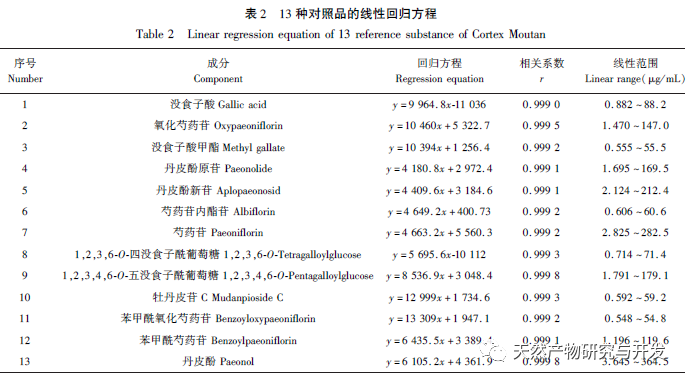
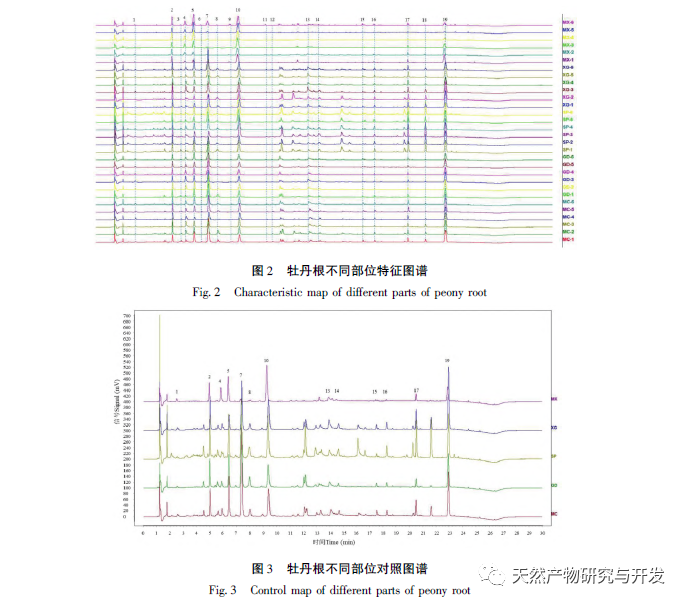
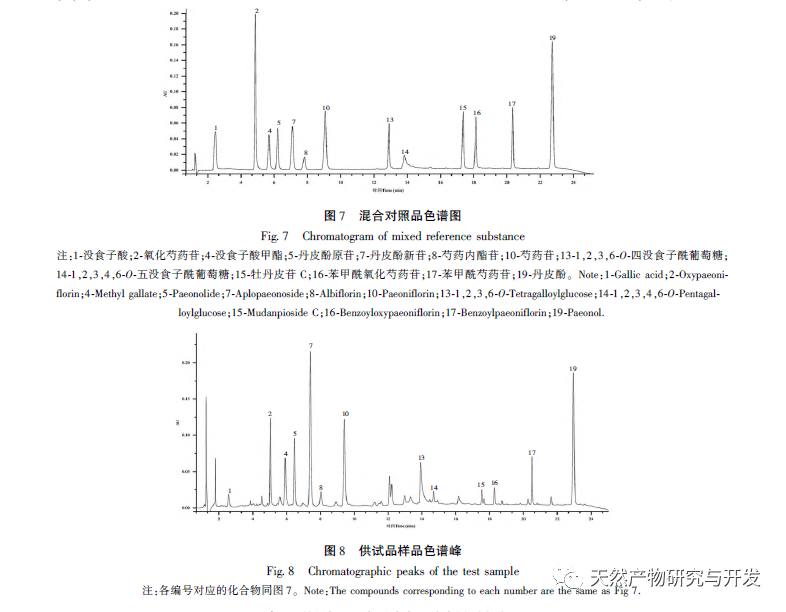
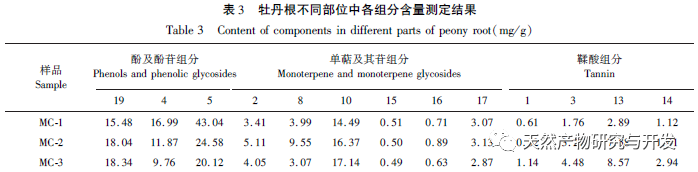
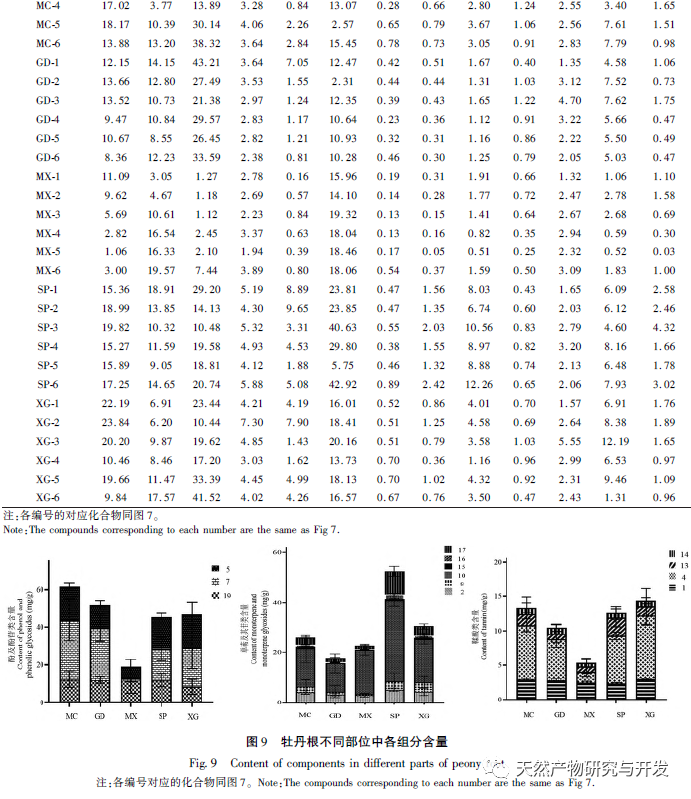
The chemical composition is the material basis for traditional Chinese medicine to exert its traditional effects, and the rational selection of indicator components for quality control and evaluation research of Chinese medicine is a key step. This study used feature maps to collect overall chemical information of five parts of peony roots during processing, and combined with a chemometric evaluation system to screen 13 differential characteristic components for content determination. Objective quality evaluation was conducted on different parts of peony bark roots.
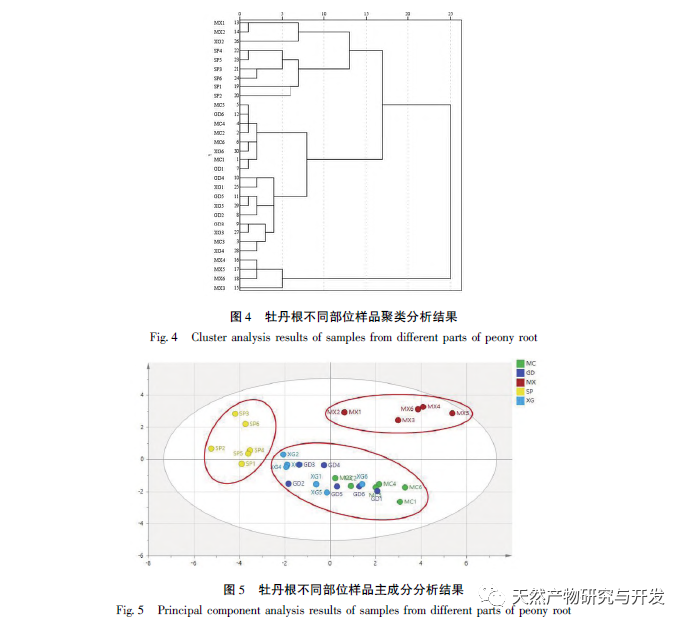
The chemical composition of different parts of peony roots was comprehensively characterized through UPLC characteristic maps, and the chemical information of connected peony bark, scraped peony bark, wood heart, cork bark, and fibrous roots was compared comprehensively. HCA and PCA analysis showed that the chemical composition of connected peony bark, scraped peony bark, and fibrous roots was similar and could be grouped together. The chemical composition of wood heart was relatively low, and the main components such as paeonol and paeoniflorin content were low, while the chemical composition of cork bark was relatively rich.
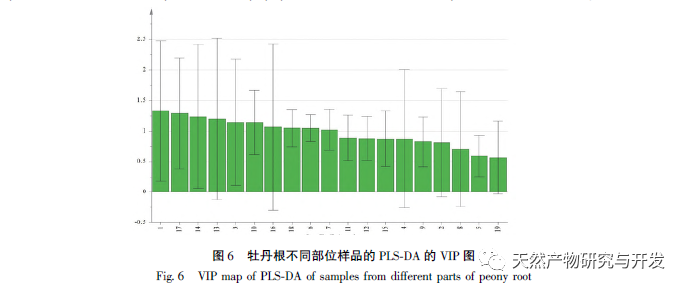
Ten characteristic differential components in different parts of peony roots were screened using PLS-DA. Seven components, including gallic acid, paeonol glycoside, paeoniflorin, 1,2,3,6-O-tetragalloylglucose, 1,2,3,4,6-O-pentagalloylglucose, benzoyl oxidized paeoniflorin, and benzoyl paeoniflorin, were identified based on the reference standard. At the same time, 13 functional components with a content greater than 0.1mg/g (oxidized paeoniflorin, methyl gallate, paeonol new glycoside, paeoniflorin lactone glycoside, paeoniflorin C, and paeonol) were combined for content determination. The chemical composition distribution of different parts of peony roots was analyzed by classifying chemical components such as phenols and phenolic glycosides, monoterpenes and their glycosides, and tannic acid components. Rule. The content determination results indicate that the chemical composition of different parts of peony roots has both similarities and differences, and the reason for the differences may be related to the synthesis and transfer of secondary metabolites during peony growth. The content of phenols, phenolic glycosides, and tannic acids in Lian Dan Pi is roughly equivalent to that in Scrap Dan Pi, but the content of monoterpenes and their glycoside components is higher than that in Scrap Dan Pi. This is consistent with the literature reports by Wu Chuncao et al., indicating that monoterpenes and their glycoside components mainly accumulate in the outermost cork layer. Shi Suying et al. found that the content distribution of monoterpene glycoside components in different parts of peony roots is greater in the cork layer than in the phloem than in the wood, suggesting that the secondary metabolism accumulation characteristics of monoterpene glycoside components in the characteristic components of Paeonia are the same. The proportion of cork bark in Liandan bark is relatively small, but it contains abundant chemical components, with a high concentration of monoterpenoid glycosides. This indicates that in terms of clinical efficacy, Liandanpi may be superior to scraped danpi, and also suggests that it is more appropriate to preserve the cork site during the processing of peony bark in the production area.
Comparing the content of active ingredients in the non medicinal parts of the peony heart, it was found that the content of characteristic ingredients measured in the heart was relatively low. As the heart is a highly lignified part of the peony root, removing the heart can improve the enrichment of active ingredients in the medicinal parts of the peony. Therefore, removing the heart during the processing of peony bark is scientifically sound. The content of phenols and phenolic glycosides, monoterpenes and their glycosides, and tannic acid components in the non medicinal parts of the fibrous roots is equivalent to that of Liandan Pi. It is regrettable to abandon them as non medicinal parts. However, it is difficult to completely separate the fibrous roots from the wood core during processing, and it is also easier to reflect the ash content, resulting in a decrease in the overall product. It is not easy to include them in the medicinal parts for quality control. Therefore, the fibrous roots can be collected for comprehensive resource development and utilization.
The differential accumulation of secondary metabolites in medicinal plants is the core issue of differences in the quality of medicinal materials from different origins and regions. This study indicates that the root bark of peony is the main organ for the accumulation of functional components and their secondary metabolites. The medicinal part of peony is the heart removed root bark, which has scientific validity. Moreover, due to the high content of monoterpenes and glycosides in the cork bark, it is more suitable to process and preserve the cork bark in peony production areas. The content of various components in the roots of non medicinal parts is not much different from that of Liandan Pi, but due to its small diameter, it is difficult to separate from the wood core and difficult to control its quality, making it unsuitable for inclusion in medicinal parts. However, it can be considered for processing in industries such as daily chemical and veterinary medicine. It is worth noting that monoterpenes and their glycosides accumulate differently in different parts of peony roots, which may be related to how secondary metabolites are synthesized and transported to medicinal parts for storage during plant growth. It is necessary to combine transcriptomics and molecular pharmacognosy to further reveal the scientific connotation, which is of great significance for the quality evaluation of peony bark.
 English
  Danish
  German
  Hungarian
  French
  Russian
  Spanish
  Turkish