
Determination of volatile components in different species of paulownia flowers using HS-SPME and GC-MS combined technology
Paulownia is a collective term for plants in the Scrophulariaceae family, belonging to the Paulownia genus. There are currently 11 species, 2 varieties, and 6 forms, naturally distributed in 24 provinces, municipalities, and autonomous regions. As an important fast-growing timber tree species originating from China, its cultivation and utilization history is very long. The main cultivation methods include fast-growing and high-yield forests, farmland protective forests, tree planting on all sides, and landscaping. Due to its well-developed root system, tolerance to barrenness, and strong adaptability, paulownia can adsorb heavy metals in its leaves, stems, and roots. Therefore, it has also attracted attention in ecological engineering fields such as ecological restoration and afforestation on difficult sites. Paulownia flowers, leaves, fruits, roots, and bark can all be used as medicine, and have good therapeutic effects on upper respiratory tract infections, bronchitis, mumps, and other diseases. Research on their chemical composition, biological and pharmacological activities has gradually become a hot topic. Previous research has isolated over 130 components from Paulownia plants and verified the biological activity of some compounds. Among them, five compounds, rutin, apigenin, luteolin, ursolic acid, and kaempferol, have been identified in the flowers of Paulownia elongata, which have the functions of lowering blood pressure, softening blood vessels, and inhibiting tumor cell proliferation; The methanol extract of paulownia flowers has a certain therapeutic effect on hand, foot, and mouth disease caused by enterovirus EV71. The ethanol extract has strong inhibitory activity against common food preservatives such as Aspergillus niger, Aspergillus oryzae, and Staphylococcus aureus. In addition to medicinal use, paulownia has a strong floral fragrance and is rich in natural aroma substances. It can still be used as a pure natural additive in food, beverages, and daily chemical products.
The resources of paulownia flowers in our country are very abundant. Compared with other tissues and organs of paulownia, they are easier to pick and have less impact on the nutritional growth of the tree after harvesting, making them more valuable for research and development. There are currently reports on the volatile components of paulownia flowers. Zhang et al. identified 67 volatile compounds from Lankao Paulownia, including olefins (41.54%), alcohols (23.92%), and esters (14.82%); Zheng et al. identified 58 compounds, including anisene (25.83%), 3-octanone (14.08%), and p-methyl anisole (12.06%), from Paulownia tomentosa; Wang et al. used steam distillation to extract the essential oil of paulownia flowers, and identified its chemical composition using GC-MS technology. A total of 69 components were obtained, with the main components being benzyl alcohol (13.276%), 1,2,4-trimethoxybenzene (8.342%), and tricosane (3.682%).
However, previous research and experimental materials were all single species of paulownia, without involving the main varieties of paulownia and the analysis of differences between different species. The extraction methods of volatile components were also inconsistent, and a systematic evaluation of the volatile components of paulownia plant flowers has not yet been conducted. Based on this, this study selected five main paulownia species grown in the same cultivation site and used headspace solid phase microextraction technology (HS-SPME) and gas chromatography-mass spectrometry (GC-MS) combined technology to determine and systematically analyze the volatile components and their relative contents in paulownia flowers, providing a reference for the accurate evaluation and efficient utilization of volatile components in different species of paulownia flowers.
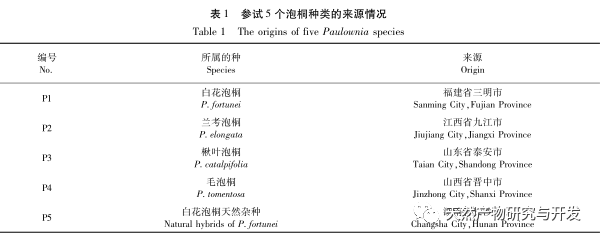
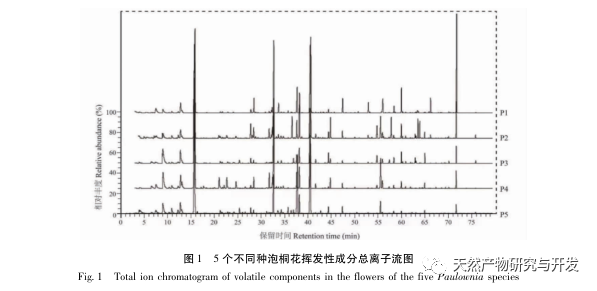
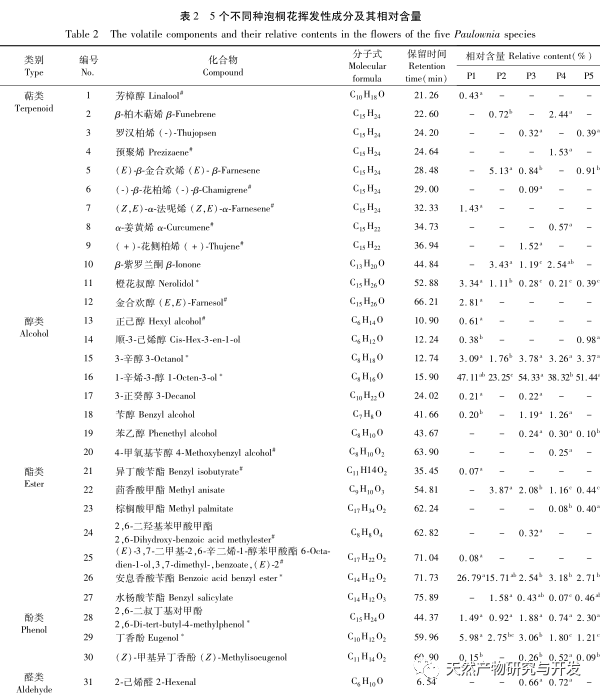
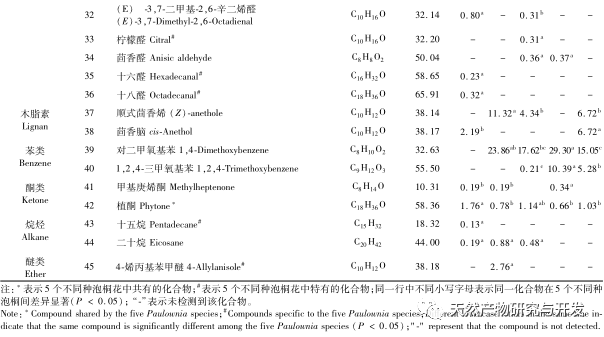
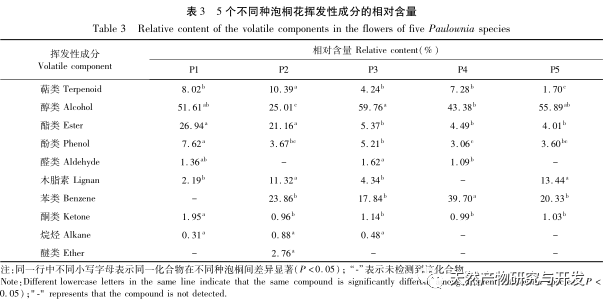
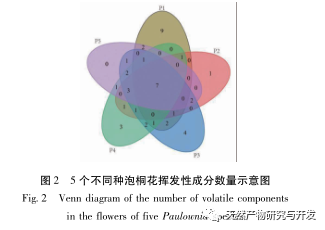
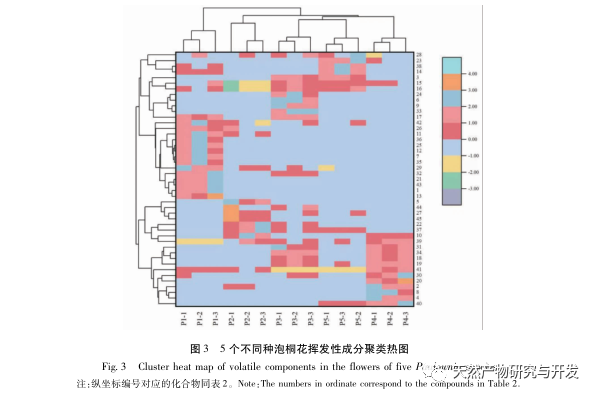
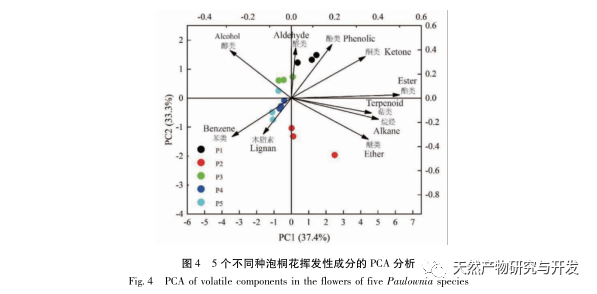
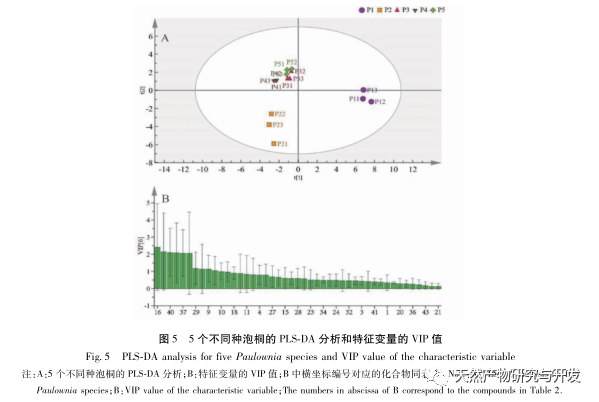 The headspace solid-phase microextraction technology for extracting volatile substances is simple, fast, efficient, with minimal sample consumption and loss of volatile substances, and does not require solvent extraction pretreatment. It has been widely used in plants such as vegetables, fruits, and traditional Chinese medicine. In this study, headspace solid-phase microextraction and gas chromatography-mass spectrometry were used to identify 45 volatile compounds from five different types of paulownia flowers mainly planted in production. Among them, 24, 17, 27, 23, and 19 volatile compounds were identified from white flowered paulownia, Lankao paulownia, catalpa leaved paulownia, Mao paulownia, and white flowered paulownia natural hybrids, respectively. Moreover, the natural hybrid flowers of catalpa leaved paulownia and white flowered paulownia were the first to extract volatile compounds. This result can provide reference for the precise evaluation and development of different types of paulownia flowers. The natural hybrid of white flowered paulownia has no unique volatile substances, which may be related to its hybrid properties. Li et al. extracted 8 compounds from white flowered paulownia flowers collected in Lanzhou, which had no common components with the white flowered paulownia flowers sourced from Sanming City, Fujian Province in this experiment; Zhang et al. used three different extraction methods to extract a total of 10 volatile compounds from the flowers of Paulownia grandiflorum. Among them, 2 compounds (1-octen-3-ol, p-dimethoxybenzene) were consistent with the results of this study and had high contents; Zheng et al. used solid-phase microextraction and gas chromatography-mass spectrometry technology to extract 58 compounds from the flowers of Paulownia trees, which shared 7 components with Paulownia trees in this experiment, mainly including 2 terpenes, 2 alcohols, 2 esters, and 1 benzene. Although the experimental materials used in the above study were the same type of paulownia, the volatile substances extracted were not entirely the same. It is speculated that this is mainly due to different extraction methods and experimental conditions. Although it is the same type of paulownia, it belongs to different varieties and variants, and the collection location is different.
Phytone, which has a herbal and woody aroma, is a characteristic volatile component of Eucommia ulmoides leaf brick tea. The terpenoid substance, orange blossom tertiary alcohol, has a floral and tree aroma similar to roses and apples. Cinnamomum camphora and β – violet ketone are important aroma components of osmanthus, and farnesol is also a contributing substance to the aroma of many aromatic plants. The above five components are important aromatic substances of paulownia flowers. It is speculated that the differences in the composition and relative content of volatile components are the main reasons for the differences in aroma between different species of paulownia flowers. As one of the traditional Chinese herbal medicines, both the “Compendium of Materia Medica” and the “Handbook of Chinese Herbal Medicine in Henan” record relevant information on paulownia flower. It has the effects of dispelling wind and heat, clearing liver and improving vision, clearing heat and detoxifying, drying dampness and stopping dysentery. It is mainly used to treat upper respiratory tract infections, bronchitis, acute flat peach inflammation, acute conjunctivitis and other diseases. In addition, paulownia flower still has antioxidant, anti-aging, blood pressure lowering, anti-cancer and anti-inflammatory effects. Research has shown that the phenolic substance eugenol has antibacterial and hypotensive effects, and has strong bactericidal power; The terpenoid substance linalool has pharmacological activities such as antibacterial, anti-inflammatory, analgesic, sedative, hypnotic, and anti-tumor effects; In addition to its antibacterial and anti-inflammatory effects, citral, an aldehyde substance, is also often used as an additive of essence and fragrance. It is speculated that eugenol, linalool and citral may be the important effective ingredients of paulownia flowers for antibacterial and anti-inflammatory. The relative content of eugenol is highest in white flowered paulownia flowers, which is consistent with Chu et al.’s belief that eugenol accumulates more under warm conditions, and linalool is a unique substance in white flowered paulownia flowers. Therefore, it is speculated that the antibacterial and anti-inflammatory effects of white flowered paulownia flowers may be more significant. Phenolic substance 2,6-di-tert-butyl-p-cresol (also known as BHT) is an important antioxidant that can be used in various foods and as a stabilizer for synthetic rubber, polypropylene fibers, etc. 1-octen-3-ol, an alcohol substance, is often used as a fragrance additive and mosquito attractant, and has significant toxic and damaging effects on the animal nervous system. Although paulownia flowers have a long history of medicinal use and various volatile components have been extracted from different types of paulownia flowers, the chemical composition and relative content of different types of paulownia flowers are different, and there is no systematic report on the pharmacological effects of different types of paulownia flowers and their correlation with chemical components, which needs further in-depth exploration.
 English
  Danish
  German
  Hungarian
  French
  Russian
  Spanish
  Turkish