
Pei Pa Koa, also known as Lute Orange, Golden Pill, Lute Branch. The loquat is native to southeastern China, with pipa-like leaves and flowers that can be used as medicine. Unlike many other fruit trees, the loquat blossoms in the fall or early winter, and the fruit ripens in the spring and summer, giving it the reputation of being “the only fruit tree that is ready for the four seasons”. The loquat fruit has a sweet and sour taste, and the flesh is soft and juicy. Because of its medicinal value and health effects, it is very popular among consumers.
Nutritional value of loquat
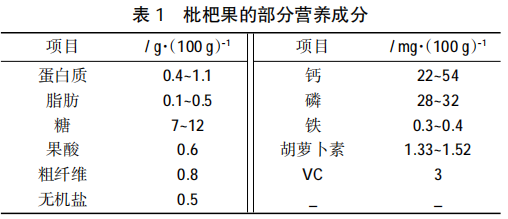
Some of the nutrients of loquat fruit are shown in Table 1.
Health effects of loquat
According to Chinese medicine, loquat fruit has the effect of moistening the lungs and stopping cough, and stomach and vomiting, can cure cough, vomiting blood, dry heat and other diseases. According to “Shennan Materia Medica” records: “loquat treatment of lung impotence, consumption, vomiting blood, cough and spit, croup, and treating children’s fright and fever”.
The rich carotene and VB1 in loquat have positive effects on protecting eyesight, keeping skin moist and healthy, and promoting fetal development.
Development of loquat bakery products
1.Pipa Soft Bread
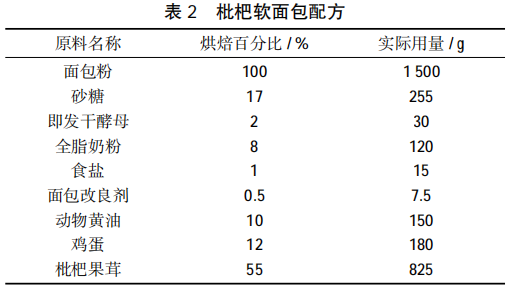
1.1 Raw material name and proportion (100% by flour)
Loquat soft bread recipe is shown in Table 2.
1.2 Process flow
Weighing material→modifying dough→relaxing→dividing dough→rolling→relaxing→shaping→plating→final rising→baking→cooling→packaging→finished product.
1.3 Equipment
Mixing machine, electronic scale (accurate to 0.1g), fermentation box, electric oven, non-stick baking tray.
1.4 Operation steps
(1) Make the dough. Pour the ingredients except loquat fruit puree, egg and animal butter into the mixing bowl, mix at low speed for 2 min, add loquat fruit puree and egg, mix at low speed for 3 min, then add animal butter, emulsify at low speed and mix at high speed until the gluten is fully extended.
(2) Loosening. Take out the dough, put it on the work surface and let it relax for 10min.
(3) Dividing and rolling. Divide the dough into 30g pieces and roll out.
(4) Plate. Put the dough into a non-stick baking tray.
(5) Rise. The temperature of the oven is 37℃, the humidity is 78%, the time of rising is 28min.
(6) Baking. Upper heat 200℃, lower heat 150℃, baking time 12min.
(7) Cooling. Put the baked bread on the cooling rack to cool naturally.
(8) Packing.
1.5 Precautions
(1) The temperature of the dough after mixing should be controlled at 28~30 ℃, the fermentation of the bread will be affected if the temperature of the dough is too high or too low.
(2) Do not shape the bread until the dough is fully relaxed.
(3) Remove the dough from the oven and leave it at room temperature until the excess water vapor evaporates from the surface before baking in the oven.
2.loquat cookies
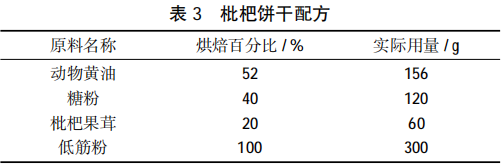
2.1 Raw material name and proportion (100% flour)
Loquat cookie recipe is shown in Table 3.
2.2 Process Flow
Weighing material → dough modification → shaping → freezing → slicing → loading → baking.
2.3 Equipment
Countertop cream mixer, refrigerator, electric oven, electronic scale (accurate to 0.1g), non-stick baking tray.
2.4 Operation steps
(1) Dough preparation. Pour animal butter and powdered sugar into the mixing bowl, mix in 1 speed for 2min, 4min in 4 speed, then add loquat fruit puree, mix in 4 speed until uniform. Add the sifted low gluten flour, mix with 1 speed to form a dough, then remove.
(2) Shaping. Take out the dough, shape into long strips, wrap with plastic wrap and roll out the strips, 4cm in diameter.
(3) Chill. Put the shaped dough into the freezer for 1h.
(4) Slice and plate. Cut the frozen dough into 0.4cm thick slices and place on a non-stick baking sheet.
(5) Bake. Top at 170℃, bottom at 180℃, baking time 25min.
(6) Cooling. Put the baked cookies on a rack to cool.
2.5 Precautions
(1) If the butter is frozen, it must be thawed and softened at room temperature or in microwave.
(2) Do not mix the sugar and oil for too long.
(3) Add low gluten powder and mix well, long time mixing will cause gluten in the dough.
3. Pipa Sponge Cake
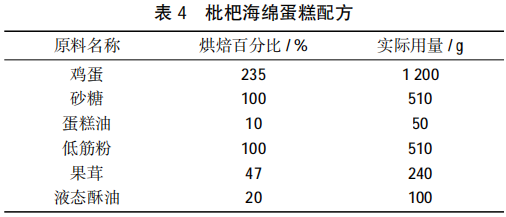
3.1 Name of ingredients and proportion (100% by flour)
See Table 4 for the recipe of loquat sponge cake.
3Weigh the ingredients→sugar and egg mixing→adding cake oil→adding low gluten flour→adding loquat fruit puree→adding liquid ghee→molding→baking→cooling.
3.3 Main equipment and utensils
Multifunctional mixer, electric oven, electronic scale (accurate to 0.1g), non-stick baking pan, baking paper cups
3.4 Operation steps
(1) Batter mixing. Eggs, sugar, low-speed mixing 1min, add flour, low-speed mixing 2 min, high-speed mixing 5min. 2 times the size of the volume, add loquat fruit puree, low-speed mixing 1min, add liquid shortening, low-speed mixing 1min can be.
(2) Molding. Put the batter into a laminating bag and squeeze into heat-resistant paper cups, usually 70 to 80% full.
(3) Baking. Upper heat 170 ℃, lower heat 200 ℃, baking time 15min.
(4) Cooling. Cool at room temperature.
3.5 Precautions
(1) If the eggs are just taken out of the refrigerator, let them stand at room temperature for 0.5h before use, which is more favorable for egg foaming.
(2) Do not overfill the paper cups with batter, so as not to overflow when it expands.
 English
  Danish
  German
  Hungarian
  French
  Russian
  Spanish
  Turkish