
National Announcement
On October 22, 2021, the National Health Commission (NHC) issued the Announcement (No.9 of 2021) on 15 “Three New Foods” including Leafy Mullein, officially approving Leafy Mullein as a new food ingredient and stipulating the following requirements for Leafy Mullein:
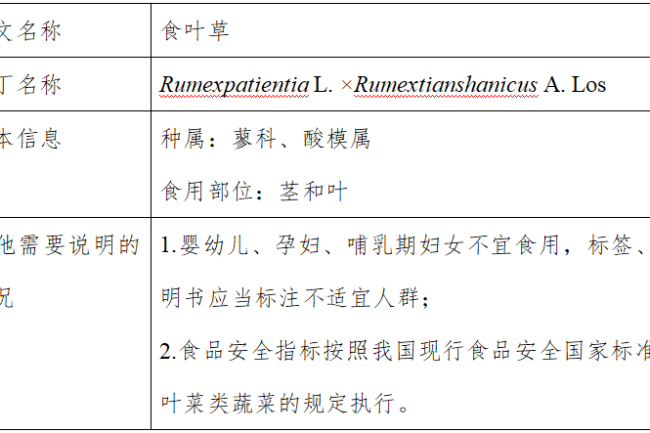
Leaf-eating grass is the introduction of Rumex K-1 acid mold and wild Batian acid mold backcrossing selection of perennial Polygonum acid mold generates the genus of herbaceous plants. Leaf-eating grass in China in Hebei, Henan, Shandong, Shanxi, Shaanxi, Gansu and other provinces are planted and eat, edible parts of the stems and leaves, edible way of cold mix, juice, stir-fry, brewing tea, making tofu and pasta, etc., did not see the crowd to eat the adverse reactions reported.
According to the “Food Safety Law” and “Administrative Measures for the Review of the Safety of New Food Ingredients”, the review body in accordance with the statutory procedures, the organization of experts to review the safety assessment of leafy grass and through the material. The production and use of new food ingredients should be in line with the content of the announcement and the requirements of food safety related regulations. In view of the lack of information on the safety of leaf-eating grass in infants, young children, pregnant women and lactating women, from the principle of risk prevention, the above groups should not be consumed, labeling and instructions should be marked inappropriate for the crowd.
The food safety index of this raw material is in accordance with the provisions of leafy vegetables in China’s current national food safety standards.
Protein Extraction of Leaf Eating Grass
Leaf-eating grass is a potential source of plant protein of high quality, according to the study, ethanol pretreatment combined with alkaline solubilization and acid precipitation method to extract leaf-eating grass protein, and the response surface test was used to optimize the extraction process. The optimized process conditions were as follows: alkali dissolution temperature 81.12 ℃, alkali dosage 10.57 g/L, material-liquid ratio 1:34.04 g/mL, and pH 3.5. Under these conditions, the yield of leaf-eating grass protein was 63.26%±1.01%, and the purity was 81.63%±2.35%.
The structural characteristics of the leaf-eating grass protein were analyzed, and the results of circular dichroism showed that the α-helix and random curl content of the leaf-eating grass protein was higher, which was 36.1% and 52.5%, respectively, which might indicate that the hydrophobicity of its surface was higher; fluorescence spectroscopy showed that the maximum fluorescence absorption peak of the leaf-eating grass protein appeared at 345 nm, which indicated that its tryptophan residue microenvironment was nonpolar; the scanning electron microscopy showed that the leaf-eating grass protein was more aggregated and in a stacked shape. Scanning electron microscopy results showed that the leaf-feeding protein was more aggregated and in the form of stacking.
By examining the functional properties of the leaf-eating grass protein, it was found that it had good solubility and emulsification under alkaline conditions, but its foaming property was poor. This study will provide data support for the application of leaf-eating grass protein in subsequent food industry production.
Nutritional Composition and Health Benefits of Leaf-eating Grasses
1. Protein
Leaf-eating grass has a high protein content and a complete range of amino acids. The protein content of leaf-eating grass is as high as more than 35%, which is 3.08 times higher than the protein content of wheat. The total amount of amino acids in leaf-eating grass can reach 35.4%, including 8 kinds of essential amino acids. The proteins and amino acids in leaf-eating grasses play an important role in regulating metabolism and enhancing human immunity.
2.Minerals
According to the literature report, every 100g leaf-eating grass contains potassium 2805mg, calcium 683mg, magnesium 456mg, iron 37.5mg, zinc 35mg, selenium 0.1mg, also contains rich sodium, phosphorus, manganese and other mineral elements; every 100g of amaranth in the calcium content of about 178mg, iron content of about 2.9mg; every 100g of spinach in the potassium content of about 311mg, magnesium content of about 58mg. Comparison found that the minerals in leafy grass are more complete, and the content is much higher than that of amaranth and spinach.
3. Vitamins
Leaf-eating grass is rich in vitamins, including vitamin C about 608mg/100g, vitamin B1 about 0.112mg/100g, vitamin E about 0.983mg/100g, vitamin B2 about 0.053mg/100g.
4.Bioactive substances
Phenolic substances and flavonoids are important active ingredients in Leaf-eating Grass, which are closely related to antioxidant activity and hypoglycemic activity. According to the determination, the total phenol and total flavonoids content in Leaf Eating Grass is 11.35mgGAE/g, 3.56mgRE/g. In addition, Leaf Eating Grass also contains carotene, chlorophyll, superoxide dismutase (SOD) and other substances.
5. Dietary fiber
The dietary fiber in the leaf-eating grass can reach 25.6g/100g, dietary fiber can promote gastrointestinal peristalsis and prevent intestinal cancer. Dietary fiber can act on fat, can effectively decompose fat, promote gastrointestinal digestion, help prevent obesity.
Application of Leaf Eating Grass
1. Rice and pasta food
Compared with rice, wheat and corn, these traditional food crops, leaf-eating grass contains more rich mineral elements, leaf-eating grass as raw material production and processing into rice, pasta and other staple foods, can play out its nutritional value.
Leaf-feeding grass is made into grass juice, mixed with potato flour and rice flour, the preparation of leaf-feeding grass health rice is not only rich in nutrients, but also can be used to prevent disease.
Leaf-eating grass pulp mixed with starch and other materials, can be prepared vermicelli, the use of leaf-eating grass in plant collagen instead of alum and other gluten enhancers, not only can effectively reduce the production cost, but also reduce the alum and other gluten enhancers mixed into the food on the human body brought about by the hazards.
2.Vegetable proteindrinks
Leaf-eating grass is known as “protein grass” because of its high protein content, and it has wide application prospects to be used in the development of plant protein drinks.
Green Hill et al. used leaf-eating grass as raw material, dried the samples, kneaded them after 12-60s of killing at 100-150℃, dried them at 120-150℃ for 2.5-5h, and then placed them in the cellar for 4-8h, which can be used to prepare leaf-eating grass functional tea beverage.
In addition, leaf-eating grass can also be used to replace animal milk and other plants to make drinks. Green Mountain and other leaf-eating grass slurry as raw material, mixed with natural polysaccharide suspending agent, preservative and other materials, can develop a low-cost, nutrient-rich leaf-eating grass plant milk.
Leaf-eating grass juice is mixed with xylitol, purified water and flavoring to prepare leaf-eating grass perishable milk, which is not only nutritious, but also can effectively avoid problems such as lactose intolerance caused by animal-source milk.
As the coloring content of leaf-eating grass is high, and the made plant beverage contains a certain degree of grassy smell, how to solve the coloring and grassy smell is a problem worth thinking about. Considering the safety of leaf-eating grass drinks, food-grade activated carbon can be used to achieve the purpose of removing pigment and odor.
3.Health care products
Leaf-eating grass is rich in polyphenols, chlorophyll, carotene, SOD and other biologically active substances, which can be separated and extracted for the development of health care products. Leaf-eating grass is used as raw material to develop leaf-eating grass health care oral liquid and capsule, which can play the role of antioxidant, beauty, reduce blood sugar and blood pressure. Leaf-eating grass mixed with licorice, ethyl malt powder and other materials, silk cigarette processing, can prepare leaf-eating grass health cigarettes.
Leaf-eating grass development prospects
Leaf-eating grass as a new food raw materials used in the field of food, is conducive to strengthening human immunity, improve the national health level, but also in line with the national “Healthy China 2030” development concept. Leaf-eating grass has a high yield, which can replace food with grass and alleviate the crisis of food shortage.
Leaf-feeding grasses contain oxalic acid, which has poor palatability and is often used as pasture and feed. Therefore, research on the technology of removing or reducing the content of oxalic acid in leaf-feeding grasses can improve the palatability of leaf-feeding grasses and the quality of their products.
At present, the functional evaluation of L. edulis focuses on antioxidant, hypoglycemic and other aspects, but the research on other aspects of functional evaluation is still insufficient. However, leaf-eating grass contains more vitamins, organic acids and other substances, the functional activities of which are yet to be developed.
In the future, we should give full play to the advantages of high yield and rich nutrition of leaf-feeding grass, carry out deep processing of leaf-feeding grass resources, carry out basic research on its nutritional and efficacy components, develop a series of functional foods, realize the full-value utilization of leaf-feeding grass, and promote the high-quality development of leaf-feeding grass industry.
 English
  Danish
  German
  Hungarian
  French
  Russian
  Spanish
  Turkish