
Effects of total flavonoids of hawthorn leaves on antioxidant enzyme activity and related gene expression in streptozotocin induced diabetes mice
Diabetes (DM) is a metabolic disease characterized by hyperglycemia. Its prevalence rate is increasing year by year in the world, and it has become the fourth disease that needs priority. Excessive blood sugar concentration can cause metabolic disorders in the body, leading to tissue damage and functional impairment. The most common form of this disease is type 1 and type 2 diabetes. The characteristics of these two types, which are caused by insufficient insulin production (type 1) or loss of cell sensitivity to insulin resulting in hyperglycemia, are called insulin resistance (type 2). Although these two types of diabetes have different causes, they are both affected by cellular oxidative stress. The core mechanism of type 1 diabetes is the specific damage of pancreatic islet β cells caused by the interaction of genetic, environmental and immune factors, resulting in absolute insulin deficiency. At present, insulin is the main drug to treat the disease, but because the special way of insulin administration affects the patient’s compliance and its own therapeutic effect, including hypoglycemic events, weight gain, ketoacidosis and other side effects, seeking drugs other than insulin to help patients with type 1 diabetes control blood sugar has important clinical significance.
Hawthorn (Crataegus Pinnatifida Bunge) is both edible and medicinal. Hawthorn leaves have various pharmacological activities such as lowering blood lipids, blood sugar, and blood pressure, as well as antioxidant properties. Hawthorn leaves are rich in various bioactive components. Li et al.’s research has shown that the polysaccharide compounds in hawthorn leaves have the ability to scavenge DPPH and OH free radicals. Hu et al. found that hawthorn leaf flavonoids can promote the clearance of free cholesterol in the liver of hyperlipidemic mice by upregulating the expression of LDLR, thereby improving lipid metabolism disorders in mice. Zhang et al. found that intraperitoneal injection of total flavonoids from hawthorn leaves can inhibit cell apoptosis and promote motor function recovery in rats with spinal cord injury. Li et al. found that total flavonoids from hawthorn leaves can significantly increase the levels of superoxide dismutase (SOD), catalase (CAT), and glutathione peroxidase (GSH-PX) in non-alcoholic fatty liver disease liver cells, reduce the content of malondialdehyde (MDA), enhance the body’s antioxidant capacity, and thus delay or prevent the progression of non-alcoholic fatty liver disease.
In this experiment, the diabetes mouse model was first established by injecting streptozotocin (STZ), and then the diabetes mice successfully established by gavage of total flavonoids from hawthorn leaf (TFHL) at different concentrations were used to explore the antioxidant effect of hawthorn leaf flavonoids on diabetes mice, providing reference and reference for the development and utilization of hawthorn and the prevention and treatment of diabetes.


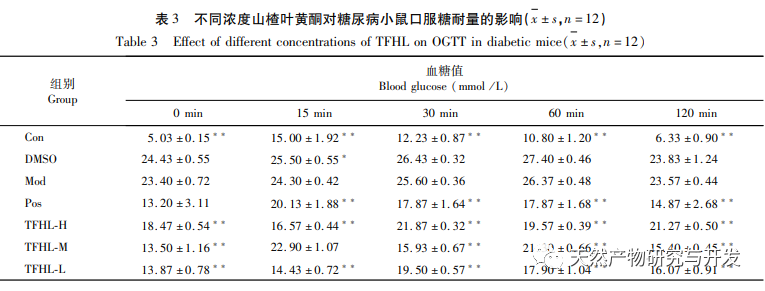
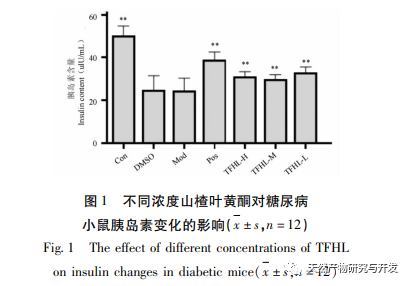
 Blood sugar is an important source of energy for the body’s cells, tissues, and organs. Oral glucose tolerance test can evaluate the function of pancreatic beta cells and glucose metabolism in the body. Huang et al. showed that total flavonoids of Houttuynia cordata Thunb could reduce blood sugar in type 1 diabetes mice. The above research shows that flavonoids have positive effects on the treatment of diabetes. The results of this experiment show that hawthorn leaf flavonoids can reduce the blood glucose concentration and improve the peak time of glucose in diabetes mice, which is consistent with the above research results. Insulin is the only hypoglycemic hormone in the body, and its content can be used to judge the degree of pathological changes in diabetes. The results of this experiment show that hawthorn leaf flavone can increase the insulin content in mice and reduce the blood sugar concentration in diabetes mice, which is consistent with the results of Zeng et al.’s research that hawthorn leaf flavone can significantly reduce the blood sugar level in diabetes mice and improve their glucose metabolism. In the results of this experiment, low-dose hawthorn leaf flavonoids showed the best effect in reducing blood sugar. This may be due to the fact that low-dose hawthorn leaf flavonoids first act on the pancreas, promoting insulin secretion and lowering blood sugar, while high-dose hawthorn leaf flavonoids first act on the liver, repairing liver damage and enhancing corresponding gene expression. This is consistent with the research findings of Zhang, Lu, and others.
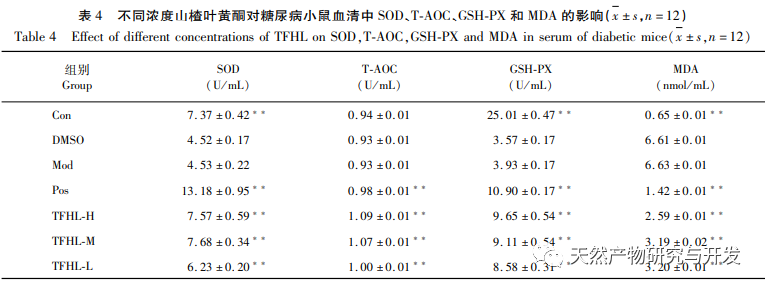
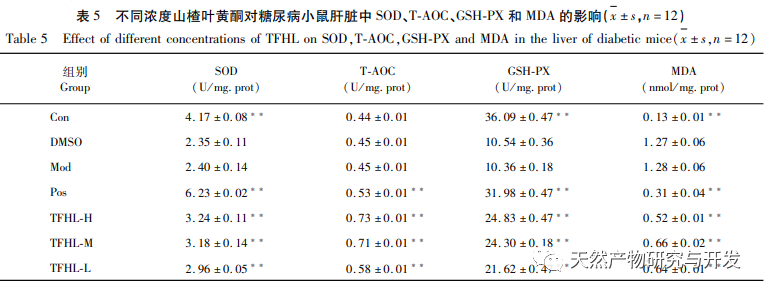
The current research shows that the pathogenesis of diabetes is complex, and its important pathogenesis is that the accumulation of reactive oxygen free radicals reduces the antioxidant capacity of the body. Liu et al.’s research shows that all three flavonoids in the leaves of Jungar hawthorn have the function of scavenging free radicals; According to this experiment, data from various groups showed that hawthorn leaf flavonoids can significantly increase the activity of antioxidant enzymes in serum and liver, and reduce the content of MDA. There may be several reasons for this. Firstly, due to the stable nature of semi Kun free radicals, the free radicals in the body can react with the phenolic hydroxyl groups in hawthorn leaf flavonoids to generate stable semi Kun free radicals, thereby terminating the chain reaction of free radicals. The termination of the chain reaction enhances the antioxidant capacity of the body. The second is that the content of MDA can increase due to lipid peroxidation, which can be caused by excessive free radicals in the body. Hawthorn leaf flavonoids can inhibit lipid peroxidation, and the MDA content in serum and liver will not increase as a result, thus enhancing the body’s antioxidant capacity. Thirdly, there are many types of flavonoids in hawthorn leaves. When there is a neighboring hydroxyl group in the B ring, the 2,3 double bonds lose electrons to the B ring and spin to generate stable free radicals. The 4-position carbonyl group can form hydrogen bonds with the neighboring hydroxyl group, making the intermediate of free radicals more stable. In addition, there is a Fenton reaction (Fe2++H2O2 → Fe3++· OH+· OH -) in cells, and vitexin can undergo complexation reaction with Fe2+, with the complexation site between 4-carbonyl-5-hydroxy. Complexation with Fe2+can effectively reduce the generation of · OH, form complex precipitation, reduce free radicals, and improve the body’s antioxidant capacity. Hawthorn leaf flavonoids can increase the activity of antioxidant enzymes in the liver and serum of type 1 diabetes mice, reduce the content of MDA, and enhance the antioxidant capacity of the body. The expression of antioxidant genes is closely related to the antioxidant activity of antioxidant enzymes.
When the degree of oxidation in the body exceeds its ability to clear oxides, the stability of the oxidation and antioxidant systems is disrupted, resulting in oxidative damage. Under low-level oxidative stress, the body’s antioxidant proteins are activated through the cis acting elements of antioxidant response elements (ARE) or electrophilic response elements (EpRE). ARE can regulate the response of antioxidant enzymes to oxidative stress in the body at the transcriptional level. Under normal physiological conditions, nuclear factor E2 related factor 2 (Nrf2) binds to epoxy chloropropane kelch sample related protein-1 (Keap1) in the cytoplasm, and its activity is inhibited. It is degraded under the action of ubiquitin protease to maintain the low transcriptional activity of Nrf2 under physiological conditions. When the cell is under oxidative stress, the originally bound Nrf2 is uncoupled from Keap1, and the activated Nrf2 enters the nucleus and forms a dimer with small Maf proteins, thereby recognizing and binding to ARE elements, initiating downstream gene transcription, and transcription of antioxidant enzymes in the body. The activity is thus increased, thus balancing the oxidative damage of the body.
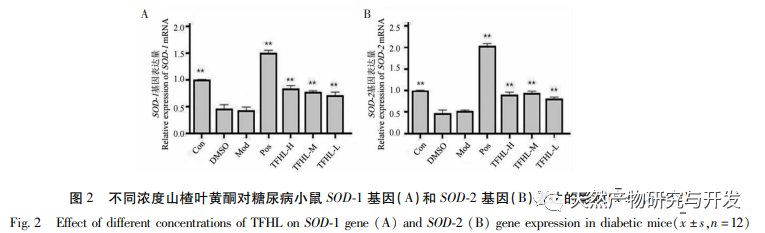
In this experiment, after the diabetes mice were fed with hawthorn leaf flavonoids for 4 weeks, the expression of four antioxidant genes, namely, SOD-1, SOD-2, GPX-1 and GPX-4, in the liver of the mice with diabetes increased significantly, which may be due to two reasons. On the one hand, because of the severe oxidative stress in the body of the mice with diabetes, the body’s antioxidant system could not balance the attack of free radicals, resulting in serious oxidative damage to cells and the body’s endogenous antioxidant system could not eliminate free radicals. Hawthorn leaf flavonoids can not only eliminate free radicals in the body, but also complex with metal ions, reduce the oxidative damage of free radicals and metal ions to cells, promote the nuclear translocation of Nrf2, and increase the free radicals. and then increase the expression of SOD-1, SOD-2, GPX-1 and GPX-4 genes in the liver of diabetes mice. On the other hand, the decrease of antioxidant enzyme activity in diabetes mice may lead to the increase of free radicals in the body, resulting in oxidative damage of cells, insufficient energy supply of the mitochondrial system and blocked DNA and RNA transcription, which significantly reduces the expression of antioxidant genes in the liver of diseased mice. As hawthorn leaf flavonoids have the effect of scavenging free radicals in vivo, after intragastric administration, DNA and RNA transcription in mouse cells were improved, and the expression of SOD-1, SOD-2, GPX-1 and GPX-4 genes in the liver of diabetes mice was increased. Deng et al. found that quercetin can activate the nuclear translocation expression of Nrf2 in human primary liver cells incubated with ethanol. Ganesan, Zhang et al.’s research shows that vitexin improves insulin secretion by activating key proteins involved in regulating apoptosis in beta cells, including NF – κ B and Nrf2. All are consistent with the results of this experiment.
The results showed that hawthorn leaf flavonoids could significantly reduce the content of MDA and significantly increase the activities of T-AOC, SOD and GSH-PX in serum and liver of STZ induced diabetes mice. Hawthorn leaf flavonoids can significantly increase the expression of SOD-1, SOD-2, GPX-1 and GPX-4 genes in the liver of STZ induced diabetes mice. To sum up, hawthorn leaf flavone can improve oxidative damage in diabetes, and has a good antioxidant effect. It has a good development prospect in the treatment of diabetes and related drug research and development.
 English
  Danish
  German
  Hungarian
  French
  Russian
  Spanish
  Turkish