
Analysis of Chemical Composition Differences between Golden Grass and Its Habitual Products Based on Liquid Mass Spectrometry
The dried whole plant of Lysimachia Christinae Hance, a member of the Primulaceae family, is mainly produced in Yunnan, Sichuan, and Guizhou provinces in China. Modern research has shown that goldenrod contains chemical components such as flavonoids, organic acids, volatile oils, tannins, and amino acids. Its main active ingredients are flavonoids and organic acids, which have the effects of promoting dampness, reducing jaundice, detoxification, and reducing swelling. It is clinically used to treat liver and gallbladder stones, damp heat jaundice, and other diseases. As a commonly used medicine in traditional Chinese medicine clinical compatibility, Jin Qian Cao often appears in the market as a common or counterfeit product. For example, in the Jiangsu and Zhejiang regions, Lianqiancao is commonly used as a medicinal herb, which has the effects of promoting diuresis, clearing blood stasis, reducing swelling, and clearing heat and detoxifying; Another common use of small goldenrod is its ability to clear heat, detoxify, promote diuresis, and disperse blood stasis. This leads to confusion in the use of medicinal herbs such as goldenrod, affecting the safety and effectiveness of clinical medication.
At present, traditional methods such as morphological identification, microscopic identification, and thin-layer chromatography (TLC) identification are commonly used for the identification of goldenrod and its common products, as well as mixed products. In addition, infrared spectroscopy and DNA barcode technology were applied to explore the comparative identification of goldenrod and its common products, as well as counterfeit products. High performance liquid chromatography (HPLC) is commonly used for the chemical composition analysis of goldenrod and its commonly used products, which measures the content of single or few flavonoids such as rutin, quercetin, and kaempferol. However, the instrument sensitivity is low and the analysis time is long, making it difficult to meet the increasingly high quality control requirements of traditional Chinese medicine. In recent years, liquid chromatography-mass spectrometry (LC-MS) technology has been widely used for qualitative and quantitative analysis of complex systems in traditional Chinese medicine due to its high separation ability in liquid phase and high selectivity and sensitivity in mass spectrometry.
This article is based on ultra fast liquid chromatography triple quadrupole time-of-flight mass spectrometry (UFLC Triple TOF-MS/MS) to analyze the differences in chemical components in goldenrod and its medicinal products, and to screen and identify the differential chemical components; Simultaneously determine the content of identified common differential components using ultra fast liquid chromatography triple quadrupole/linear ion trap mass spectrometry (UFLC-QTRAP-MS/MS), and compare and analyze the content of Jinqian grass with Xiaojinqian grass and Lianqian grass. This study can provide new methodological references for the identification and quality control of medicinal materials such as goldenrod and its medicinal products, as well as basic information for revealing their differences in efficacy and rational clinical use.
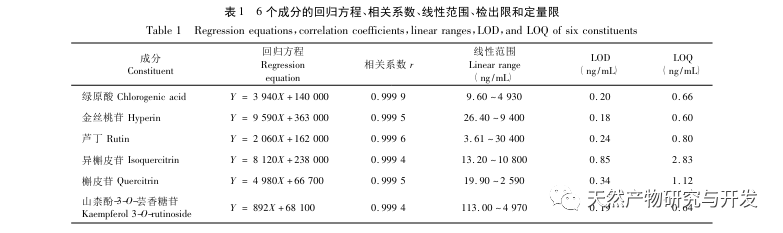

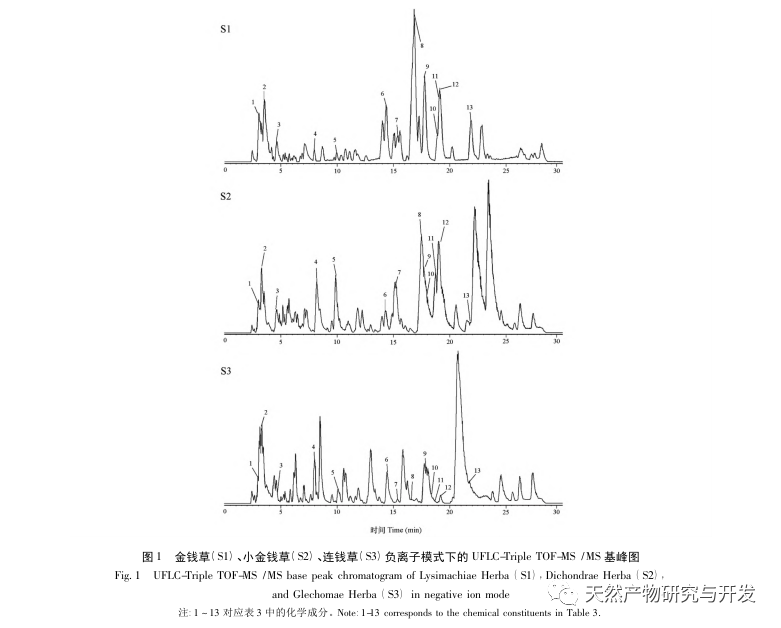
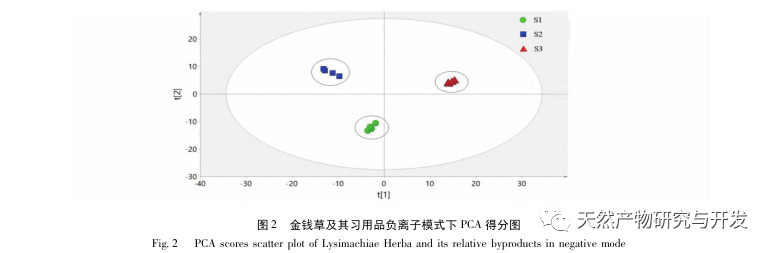
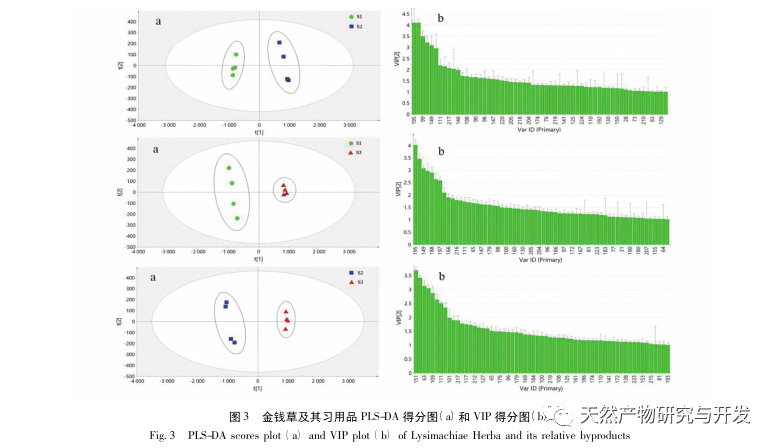

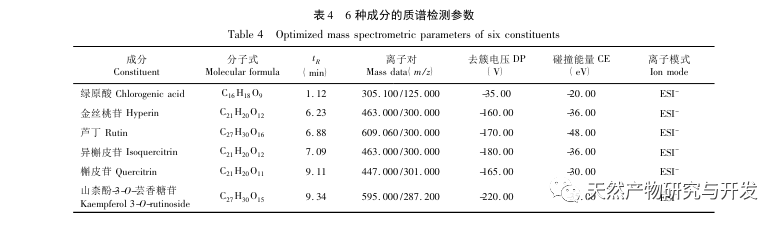

 This article first referred to the idea of plant metabolomics and established the UFLC Triple TOF-MS/MS method. Firstly, PCA was used, and the results showed that the samples of Lonicera japonica, Lonicera japonica, and Lonicera japonica were distributed in three different regions on the coordinate axis, indicating that there were differences in their chemical compositions. Based on the VIP values and t-test results obtained from PLS-DA, 13 differential chemical components were screened and identified, among which 6 were common differential chemical components, namely chlorogenic acid, hyperoside, rutin, isoquercitrin, quercitrin, and kaempferol-3-O-rutinoside. The six components can be further classified into one organic acid compound and five flavonoids. Flavonoids and organic acid compounds have significant contributions in anti-tumor, anti-inflammatory, vascular protection, and antioxidant properties. According to literature records, Chinese wolfberry, Chinese wolfberry, and Chinese wolfberry are all effective in treating stones. Among them, Chinese wolfberry is more effective in treating urinary tract stones in clinical practice, while Chinese wolfberry is more suitable for treating liver and gallbladder stones. In addition, Xiaojinqiancao is a commonly used medicine for treating hepatitis in Miao folk culture. The differences in chemical composition and content may be the reason for the inconsistent efficacy and clinical use of the three. Therefore, simultaneous determination of the content of these six common differential chemical components and analysis of the changes in the content of differential chemical components in Jinqiancao and its medicinal products are of certain significance for exploring the material basis of the differences in pharmacological effects of Jinqiancao, Xiaojinqiancao, and Lianqiancao.
A method was established to simultaneously determine the content of six differential chemical components using UFLC-QTRAP-MS/MS. The results showed that rutin and kaempferol-3-O-rutinoside had relatively high content in Scutellaria baicalensis, while the other four components had higher content in Scutellaria baicalensis. Among them, the content of rutin in the sample of Lonicera japonica was the highest, with an average content of 127.16 μ g/g, which was 2.4 times that of Lonicera japonica and 71 times that of Lonicera japonica; The content of quercitrin in the sample of Xiaojinqian grass is the highest, with an average content of 177.30 μ g/g; The content of chlorogenic acid in the samples of Lianqiancao is the highest, with an average content of 66.83 μ g/g. Modern pharmacological research has shown that rutin has strong antioxidant capacity and has pharmacological effects such as anti-inflammatory, antibacterial, antiviral, and anti-tumor; Yu et al. verified through in vitro cell experiments that kaempferol-3-O-rutinoside has pharmacological activities of anti-inflammatory and endothelial protection, and both rutin and kaempferol-3-O-rutinoside have neuroprotective effects; Hypericin can improve cardiovascular function and has anti-tumor, antidepressant and other effects; Chlorogenic acid can treat metabolic diseases and has pharmacological effects such as antibacterial and anti-inflammatory; Quercetin and hyperoside have similar pharmacological effects, including anti-tumor and antidepressant effects, as well as potential hypoglycemic and lipid-lowering effects; Isoquercitrin has various pharmacological effects such as cardiovascular protection, anti stress, blood glucose lowering, and anti allergy. There are significant differences in the content of the six components, all of which have a wide range of pharmacological effects, which may be the reason for the inconsistency of medicinal functions and indications. However, due to the presence of multiple components and targets in traditional Chinese medicine, their therapeutic effects are the result of synergistic effects. Therefore, the material basis for the differences in clinical efficacy still needs further in-depth research.
This article is based on the combination of UFLC Triple TOF-MS/MS, PCA, and PLS-DA to explore the differences in chemical components in goldenrod and its medicinal products. UFLC-QTRAP-MS/MS is used to simultaneously determine the content of six common differential components. This study can provide new methodological references for the identification and quality control of medicinal materials such as goldenrod and its medicinal products, as well as basic information for revealing their differences in efficacy and rational clinical use.
 English
  Danish
  German
  Hungarian
  French
  Russian
  Spanish
  Turkish