
Identification of Chemical Components in Bai Ji Zhong and Study on the Inhibition Mechanism of Staphylococcus aureus
Antibiotics are considered the most “miracle drugs” of the 20th century. However, due to the overuse of antibiotics by people, bacterial resistance has emerged. It is expected that by 2050, the global property losses caused by bacterial infections to humans will reach $100 trillion. Staphylococcus aureus is a common foodborne pathogenic bacterium that can cause respiratory, digestive, and urinary tract infections. At present, the antibacterial drugs used in clinical practice have problems such as limited structural types, frequent toxic side effects, and increased drug resistance. Therefore, there is an urgent need for people to develop new types of antibacterial drugs.
Natural products are still considered a treasure trove of resources for the discovery of new drugs. According to the US Food and Drug Administration (FDA), over half of clinical drugs are derived from natural products or their synthetic derivatives, and approximately 200 natural antibiotics from microbial sources are directly used as drugs.
Baiji, also known as hyacinth orchid, hyacinth baiji, or Ulan, has its tubers often used as medicinal parts. Its taste is sweet, bitter, and astringent, with a slightly cold nature. It has the effects of astringency, hemostasis, swelling reduction, and muscle regeneration. Commonly used for the treatment of coughing up and vomiting blood, external bleeding, ulcers and toxins, skin cracking, ulcer bleeding, etc. Its main components include polysaccharides, phenanthrene, phenanthrenequinone, dibenzene, triterpenoids, lignans, and organic acids. Pharmacological studies have shown that Bai Ji has various biological activities such as anti-inflammatory, anti fibrotic, anti-tumor, and immune regulation, but there are few reports on its antibacterial mechanism. Therefore, in this experiment, Staphylococcus aureus was taken as the research object to investigate the difference in antibacterial activity between the extract and the monomer compound. By measuring the alkaline phosphatase (AKP), DNA leakage degree, and bacterial electron microscopy morphology in the bacterial solution, the effect of the compound on the cell membrane wall of Staphylococcus aureus was examined, providing a theoretical basis for the comprehensive utilization of Staphylococcus aureus and the development of new antibacterial agents.
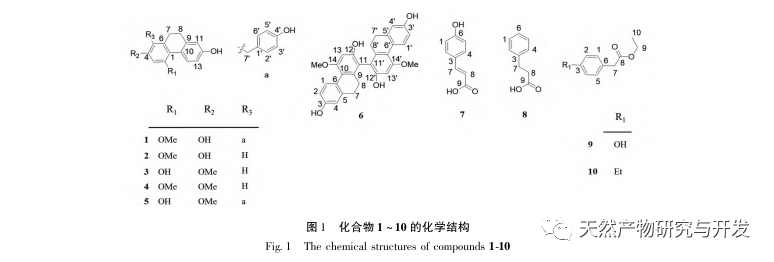
 This experiment focuses on antibacterial activity and uses chromatographic separation technology to isolate and purify the chemical components of traditional Chinese medicine Baiji. A total of 10 compounds (1-10) were isolated and identified, including 6 phenanthrene compounds (1-6) and 4 coumaric acid analogues (7-10). The discovery of coumaric acid analogues for the first time in plants of the genus Platycodon has important guiding significance for the rich chemical composition of plants in the Orchidaceae family.
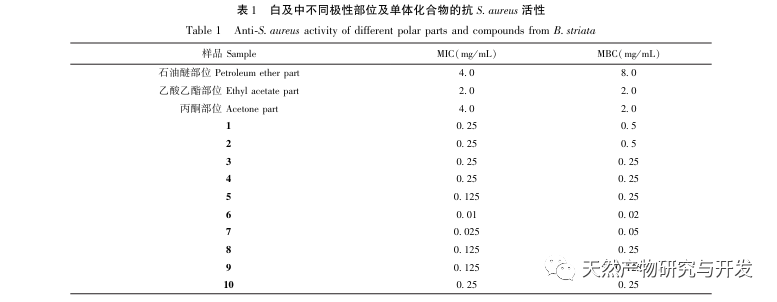
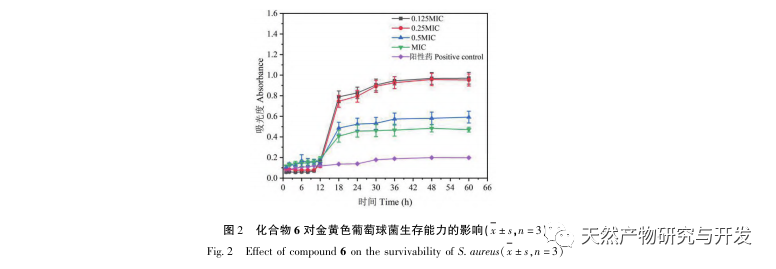
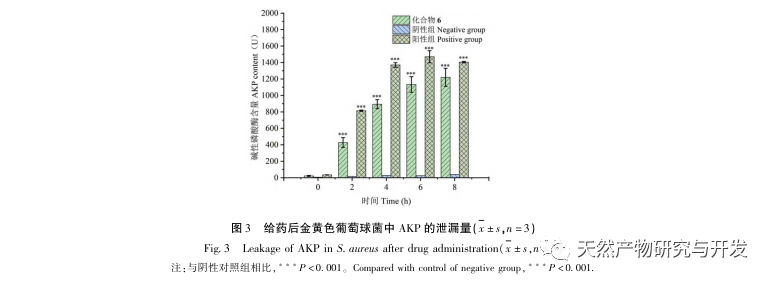
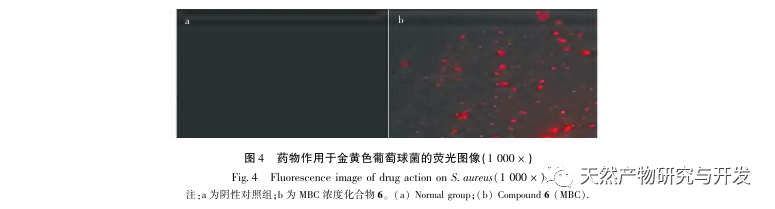
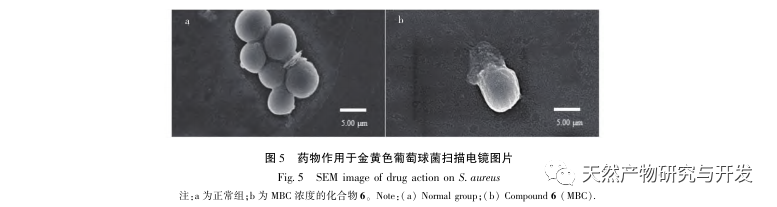
In the exploration of the antibacterial mechanism of compounds, the antibacterial activity of extracts and monomer compounds was first screened. The test results showed that compound 6 had the best antibacterial activity against Staphylococcus aureus (MIC0.01mh/mL) among the tested compounds, and the antibacterial effect was dose-dependent. The SEM results showed that the compound damaged the bacterial cell wall and membrane, causing leakage of intracellular substances. In addition, the changes in AKP enzyme content and the fluorescence intensity of PI probe further demonstrated the damage of compound 6 to bacterial membranes. In clinical use, extracts of Atractylodes macrocephala can accelerate wound healing and prevent infection, indicating that the antibacterial properties of Atractylodes macrocephala may be related to compound 6 and other phenanthrene derivatives.
From the perspective of structural types, phenanthrene compounds are natural products with completely different structures from commercially available antibiotics (β – lactams, macrolides, quinolones). In this study, phenanthrene compounds have shown good antibacterial effects, which provides inspiration for the abundance of current antibacterial drugs. The development of new phenanthrene antibiotics is expected to solve the problem of drug-resistant bacteria. According to literature reports, even the same type of phenanthrene compounds can exhibit different antibacterial mechanisms. For example, blestricin mainly inhibits the growth of Staphylococcus by disrupting bacterial membrane potential and integrity, while aristoloxazine C inhibits the growth of Pseudomonas aeruginosa by inducing cell wall degradation and ablation. Structurally, phenanthrene compounds are easily converted into quinones in living organisms, leading to the production of semiquinone free radicals and the formation of antibacterial activity. This suggests that it is necessary to further investigate the antibacterial mechanism of phenanthrene compounds. In summary, our research has preliminarily confirmed the antibacterial mechanism of phenanthrene by disrupting bacterial membranes, providing experimental data for the pharmacological substance basis of white and antibacterial agents.
 English
  Danish
  German
  Hungarian
  French
  Russian
  Spanish
  Turkish