
Study on Chemical Components of Marine Fungi Aspergillus jensenii SS5
The ocean is the largest surface resource on Earth, with enormous biodiversity and an important source of natural products. Especially the diverse marine microorganisms, which are largely unexplored. Marine fungi have unique metabolic pathways, survival and reproduction methods, and adaptation mechanisms in extreme living environments, resulting in the production of structurally novel and biologically active secondary metabolites. This has attracted close attention from scientists both domestically and internationally, and has become the most promising source of new marine natural product drugs. It is also one of the hotspots in the development of new lead compounds.
Aspergillus is widely distributed in both terrestrial and marine environments, and marine Aspergillus has been shown to have the ability to produce a large number of structurally diverse secondary metabolites. In 1992, Numata et al. reported the first natural product derived from marine Aspergillus, opening the chapter in the study of secondary metabolites of marine Aspergillus. As of 2018, the number of new natural products derived from marine fungi reported in research has exceeded 979, including polyketones, alkaloids, terpenes, macrolides, amides, steroids, halogenated compounds, peptides and other types. This series of secondary metabolites of marine fungi have various biological activities such as anti-tumor, antiviral, free radical scavenging, antioxidant, neuroprotective, anti-inflammatory, anti cardiovascular and cerebrovascular diseases, antibacterial and insect resistance. For example, the compound aurasperone H was extracted from the fermentation product of marine fungus Aspergillus niger and showed significant cytotoxicity against human acute promyelocytic leukemia cell line HL-60. The diphenyl ether compound diorcinol D obtained from the fermented crude extract of marine fungus Aspergillus jensenii LW128 exhibits excellent antibacterial activity. It is necessary to further conduct in-depth research on rare marine Aspergillus fungi, fully explore their biosynthetic potential, and obtain more natural products that can be developed as prodrugs. Therefore, this experiment focuses on the isolation of marine fungus Aspergillus jensenii SS5 from marine sediments in the South China Sea, and identifies the chemical composition of its fermentation products in order to obtain secondary metabolites with significant cytotoxic activity, providing new ideas for the design of small molecule cancer treatment drugs.


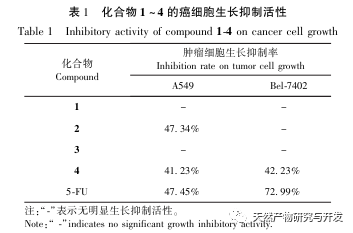
From marine fungus A Four compounds were isolated from the crude extract of Jensenii SS5: epigriseofulvin (1), sterigmatocystin (2), brevianamide M (3), and meleagrin (4). Compounds 1-3 were first isolated from marine A The isolation from Jensen ii greatly enriched the A. genus of Aspergillus fungi The diversity of secondary metabolite structures in Jensen ii. A large number of research results have proven that marine Aspergillus fungi are important sources of various secondary metabolites with rich biological activities. Many new natural products derived from marine Aspergillus have good anti-tumor, antiviral and other biological activities. Therefore, this article tested the cytotoxicity of four compounds, and the results showed that compound 4 can effectively inhibit human lung cancer A549 cells and human liver cancer Bel-7402 cells. Compound 2 has a good inhibitory effect on A549 human lung cancer cell line. These two compounds are expected to be further studied as anticancer prodrugs, and this study also provides a theoretical basis for the development of natural active compounds
 English
  Danish
  German
  Hungarian
  French
  Russian
  Spanish
  Turkish