
Starch acetate is a kind of starch with high viscosity, high clarification, weak coagulability and stable storage, which is used as thickener, stabilizer and binder in food processing, and is used in appropriate amount in raw and wet noodle products, minced meat products and so on according to production needs.
In terms of the amount of starch acetate used, China GB 2760-2014 does not limit the maximum dosage, and it can be added to each food as needed. According to research reports, adding a certain amount of modified starch in the production process of noodle products can improve the comprehensive quality of the product Yuan delay the aging of noodle products, what is the effect of starch acetate on the characteristics of flour?
The effect on flour quality
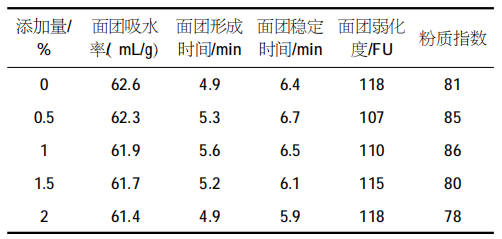
Flour quality indexes mainly include 5 aspects: dough water absorption, dough formation time, dough stabilization time, dough weakening degree and flour quality index.
The results of the flour quality test are shown in Table 1 when 0.5~2 % of acetate starch was added to the flour in different amounts.
Table 1 Effect of acetate starch on flour quality
From the analysis of the data in Table 1, it can be seen that the water absorption rate of the dough decreases linearly with the increase of the amount of starch acetate, and the percentage of decrease is not more than 1% each time, which indicates that the effect of starch acetate on the water absorption rate of flour is relatively small;
Dough formation time increases and then decreases with the increase of the addition amount of acetate starch, and reaches the maximum when the addition amount is 1%, which shows that acetate starch has some influence on the formation time of flour, but the influence is small;
Dough stabilization time increases and then decreases with the increase of the amount of starch acetate added, the longest stabilization time when the amount of starch acetate added is 0.5%, and the shortest stabilization time when the amount of starch acetate added is 2%.
The effect of the amount of starch acetate added to the dough weakening degree showed a trend of decreasing and then increasing, the amount of starch acetate added to 0.5% when the degree of weakness is the smallest, from 118FU to 107FU, down 9.3%, then with the increase in the amount of starch acetate added to the trend of rebound, the amount of starch acetate added to 2% and do not add the same degree of weakening, and the previous indicators, compared with the amount of starch acetate added to the face of the degree of weakness of the effect of the Compared with the previous indexes, the effect of starch acetate addition on the degree of weakening is larger;
Flour quality index with the increase of the amount of starch acetate added, first increase and then decrease, the measured data are 81, 85, 86, 80, 78 FU, the increase and decrease are 4.9%, 6.2%, 1.2%, 3.7%, respectively, which can be seen that starch acetate has a greater impact on the flour flour quality index.
The most important indexes affecting the flour quality are the degree of weakening and stabilization time, when adding 0.5 %~2 % of acetate starch, the change of the degree of weakening and stabilization time is less than 10%, therefore, adding 0.5 %~2 % of acetate starch has less effect on the flour quality.
Influence on dough stretching
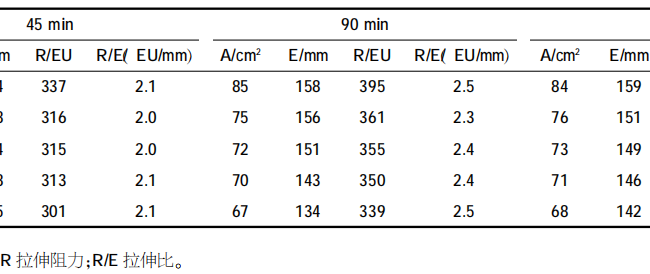
Dough stretching indexes mainly include: stretch area, stretch degree, stretch resistance and stretch ratio. When the addition amount of acetate starch was 0, 0.5 %, 1 %, 1.5 % and 2 %, the stretching of flour was shown in Table 2.
Table 2 Effect of acetate starch on dough stretching
As can be seen from Table 2, first, the stretching time of 45, 90, 135min, respectively, the stretching area of the dough with the increase in the amount of starch acetate added to the 0.5 % additive, from 75, 85, 84cm2 fell to 69, 75, 96cm2, respectively, a decline of 8%, 11.7%, 9.5%, in 2% additive amount there is a decline in 63, 67, 68cm2, the percentage of decline in order of 63, 67, 68cm2, 1.5 %, 2% additive amount of starch acetate on the stretching of the dough is shown in Table 2, 68 cm2 at 2% addition, and the decreasing percentages were 16%, 21.2% and 19%, which showed that the starch acetate had a greater effect on the dough stretching area;
Secondly, the dough elongation decreased with the increase of the addition amount of acetate starch, and the elongation decreased by 11.6%, 15.2% and 10.7% when the addition amount was 2% and the processing time was 45, 90 and 135 min, respectively, so that acetate starch had a greater effect on the elongation;
Thirdly, the dough tensile resistance decreased with the increase of the amount of starch acetate added, under 45min, with the increase of the amount of addition, it decreased from 0.5 % to 2 % by 3.7%, 6.1%, 9.8%, 11.6%, respectively, and the change amount at 90min was 8.6%, 10.1 %, 11.4%, 14.1%, respectively, and at 135min, the value of the decrease was from 6.4 % to 10.5 %. The elongation changes more with the amount of acetate starch added, and it can be assumed that acetate has a greater effect on it;
Fourthly, the dough stretch ratio was basically unchanged with the increase of the amount of starch acetate added, which was because the tensile resistance and elongation of the dough decreased by the same amount after the addition of starch acetate, so the stretch ratio remained unchanged. The most important index that affects the stretching quality of dough is the stretching area, when 2% of acetate starch is added, the change of stretching area is more than 10%, therefore, adding 2% of acetate starch has a greater effect on the stretching of flour.
Influence on the whiteness of flour
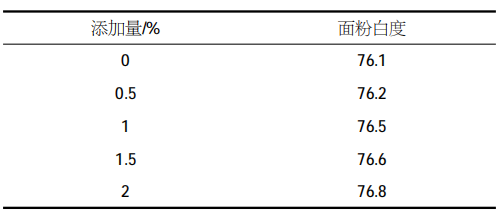
One of the indexes for evaluating the grade of flour is whiteness, and the lower the whiteness value, the lower the quality of flour. Therefore, the whiteness of flour has an important influence on wheat cultivation, milling industry and pasta industry. Table 3 shows the effect of different added amount of acetate starch on the whiteness of flour.
Table 3 Application of acetate starch on flour whiteness
Whiteness is one of the main indexes for evaluating the grade of flour, and the whiteness of flour has an important influence on wheat cultivation, milling industry and noodle food industry. As can be seen from Table 3, the whiteness of flour increases slightly with the increase of the addition of acetate starch, and the whiteness increases from 76.1 to 76.2, 76.5, 76.6 and 76.8 respectively when the addition is increased from 0.5% to 2%.
Although the whiteness value of flour after adding acetate starch is high, the increase is not more than 1%, so the effect of acetate starch on the whiteness of flour is small.
Our wheat flour grade standard requirements for whiteness is: the first level is more than 76, the second level is more than 75, the third level is more than 72, the whiteness value of flour is high, and the quality is high. The above test results show that acetate starch slightly improves the whiteness of flour and increases the quality of flour.
Effect on wet gluten content of flour
The protein part with elasticity in dough is gluten, and the main components of gluten are alcohol soluble protein and wheat gluten. Both are insoluble in water, but when water is absorbed to form a gelatinous substance is gluten.
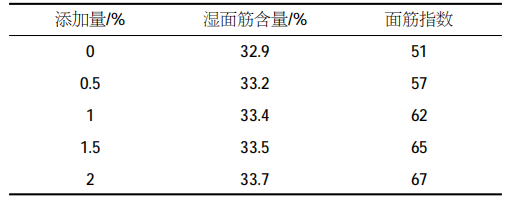
Some studies have pointed out that steamed bread shrinkage, not smooth, etc. and gluten content. The effect of different added amount of acetate starch on the wet gluten content of flour is shown in Table 4.
Table 4 Effect of acetate starch on wet gluten content of flour
Analyzing the data from Table 4, on the one hand, the wet gluten content increased from 32.9% to 33.2%, 33.4%, 33.5 %, 33.7% with the increase of acetate starch addition, with the highest increase of 2.4%, which indicates that acetate starch has a promoting effect on the formation of wet gluten in flour, but the effect is small;
On the other hand, the gluten index increased with the increase of the addition of acetate starch by 11.8%, 21.6%, 27.5% and 31.4%, which indicated that acetate starch had a greater effect on the wet gluten index.
Wet gluten content and gluten index is one of the main indexes of the grade of special flour, and the pasta products that need to be made with high gluten flour require high wet gluten content and gluten index of the flour, therefore, the effect can be enhanced by adding a certain amount of acetate starch.
Effect on the landing value of flour
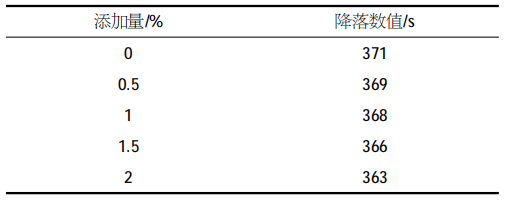
Landing value is one of the quality indexes of wheat flour, which is used to react to the size of α-amylase activity in wheat grain, the smaller the value is, the larger the α-amylase activity is; on the contrary, the smaller the activity is, Table 5 shows the effect of different amounts of acetic acid ester starch on the landing value of flour.
Table 5 The effect of acetate starch on the landing value of flour
From the analysis of the experimental data in Table 5, it is concluded that the landing value of flour decreases with the increase of the addition of acetate starch, and the landing index decreases from 371s to 369, 368, 366 and 363s in turn.
Addition of 2% of the landing value of the largest change, down 2.4%, can be seen that the starch acetate on the landing value of the flour has a small impact.
The decrease in the landing value after the addition of acetate starch indicates that, on the one hand, acetate starch can increase the pasting viscosity and stability of flour; on the other hand, different noodle products, which need moderate landing value, can be adjusted by adding a certain amount of acetate starch.
Therefore, the addition of acetate starch to flour is beneficial to the production of pasta products requiring higher landing value and higher viscosity.
 English
  Danish
  German
  Hungarian
  French
  Russian
  Spanish
  Turkish