
Research progress on chemical composition detection and material basis of traditional Chinese medicine odor
Odor is an important sensory indicator of traditional Chinese medicine, and has been used as one of the quality identification indicators since ancient times to determine the authenticity, quality, and superiority of Chinese medicine. Traditional Chinese medicinal materials containing volatile components mostly have a special odor, which is often described as having a strong aroma, a strong odor, a sour odor, a fishy odor, or a unique odor. The degree of odor is generally described as strong, weak, or odorless. The fragrant aroma of sandalwood and the pleasant aroma of benzoin are called aroma; Ferula, which has a garlic like foul odor, and realgar, which has a unique odor, are called stinky; There are also traditional Chinese medicines with a high proportion of organic acids, which not only have a sour taste but also often present a sour aroma, such as black plum, Cornus officinalis, and hawthorn; The pungent and fragrant scent is like that of earthworms, goat horns, tiger bones, and leopard bones; The odors of gentian, windproof, saffron, etc. are difficult to describe in detail and are often described as “qi specific”; The odors of Fritillaria, Chonglou, Baiqian, Banlangen, etc. are very faint and belong to the category of mild qi; Laizi, oysters, pearls, natural copper, and pistil stones are odorless or have no odor.
Like taste, the presentation, perception, and even efficacy of traditional Chinese medicine odor are also based on chemical substances. The aromatic aroma of plants is usually composed of dozens of volatile components, including hydrocarbons, alcohols, aldehydes, ketones, and other chemical components. Common representative volatile components include limonene, linalool, citral, menthone, thymol, menthol, 7-trans anethol, ethyl geranyl ester, cinnamic acid, etc. The changes in the odor of traditional Chinese medicine are directly related to the changes in chemical composition, which in turn affects clinical efficacy. With the continuous advancement of sensory analysis technology in the food industry in recent years, there has been an increasing number of technical means used for the study of traditional Chinese medicine odors. The analysis and interpretation of traditional Chinese medicine odors have also become a hot topic in modern research on traditional Chinese medicine. This article provides a systematic review of the detection methods of traditional Chinese medicine odors and the research progress on chemical substances.
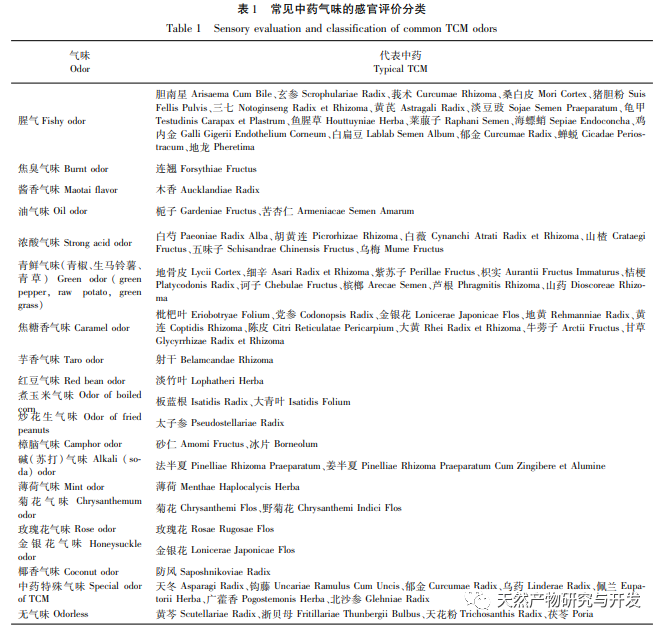
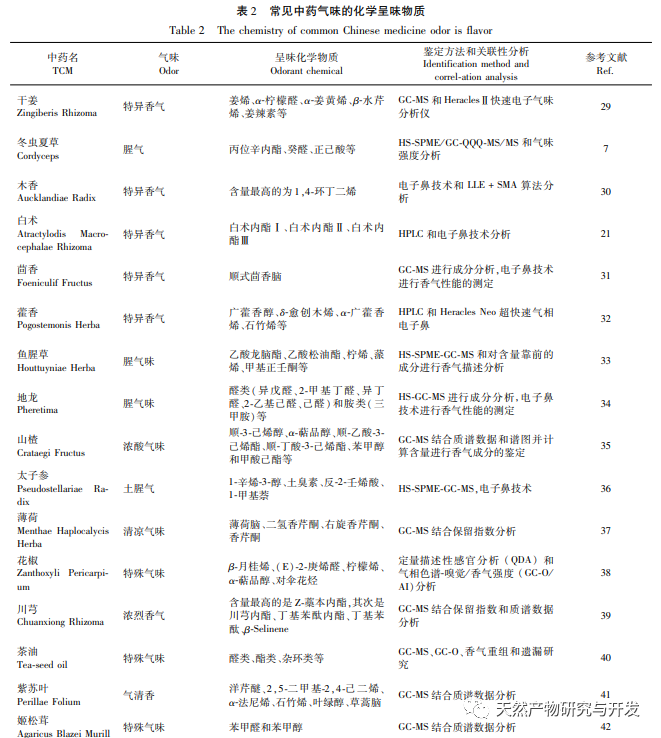
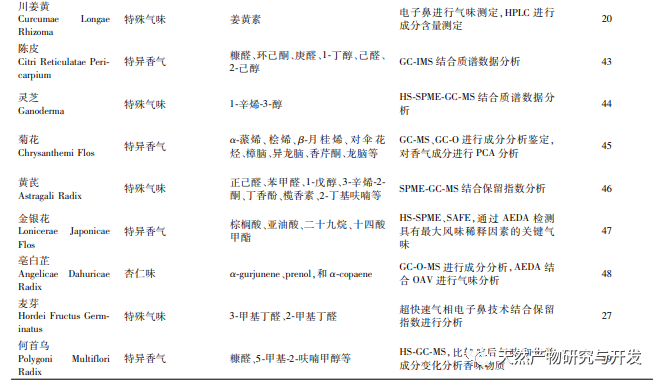
Compared with the active research on flavor substances in the food industry, the current research on the odor of traditional Chinese medicine is not deep and systematic enough. The research mainly focuses on the chemical composition, formulation process, and pharmacological effects of volatile oils, as well as the use of sensory analysis equipment for modern characterization and differentiation of traditional Chinese medicine odors, and explores the correlation between chemical components and their pharmacological effects through spectrum effect and spectrum flavor research. However, there is a lack of sufficient basic research support for the chemical composition and masking of traditional Chinese medicine odors (in the direction of traditional Chinese medicine flavor masking) and simulation (in the direction of traditional Chinese medicine placebo). Volatile oils, as representative components of traditional Chinese medicine odor, have achieved good results in the prevention and treatment of cardiovascular diseases, antibacterial, anti-tumor, and anti hyperlipidemia effects; The aroma of traditional Chinese medicine exerts its therapeutic effects in the form of volatile oils, so the overall quality control and pharmacological effects of traditional Chinese medicine aroma are gradually being emphasized. Nowadays, traditional Chinese medicine volatile oils are often prepared into nasal microemulsion aerosols, aromatherapy agents, and other nasal administration preparations to alleviate symptoms such as insomnia and anxiety. Based on research trends and technological advancements in related fields, further progress may be made in the study of traditional Chinese medicine odors in the following areas.
In the context of intelligent sensory sensor applications. The application of intelligent sensory devices in the sensory evaluation of traditional Chinese medicine has been a research hotspot in recent years. The use of new biomimetic materials to obtain stable, reproducible, and quantifiable sensory information carries researchers’ expectations for the standardization of sensory information in traditional Chinese medicine. In recent years, electronic noses have been widely used for sensory evaluation of traditional Chinese medicine odors. The current development trend of electronic noses lies in the development of new and durable biomimetic materials, as well as the optimization of software and data algorithms. At present, there are three types of gas sensors that are widely researched and applied: metal oxide semiconductor sensors (MOS) for measuring surface resistance changes after gas adsorption, conductive polymer gas sensors (CP) for measuring impedance changes, and quartz crystal microbalance (QCM) for measuring oscillation frequency changes. Although MOS has advantages such as low price, easy mass production, and good stability, its selectivity is not high. As the largest and most widely used type of gas sensor in the world, MOS can improve its sensitivity and selectivity through nanotechnology and doping, which may take intelligent sensory devices to the next level. The algorithms used for qualitative analysis of electronic noses include: nearest neighbor (NN), discriminant analysis (DA), principal component analysis (PCA), artificial neural network (ANN), probabilistic neural network (PNN), learning vector quantization (LVQ), self-organizing map (SOM), etc. Among them, PCA and ANN are the most widely used. Compared with qualitative identification, quantitative analysis not only has lower accuracy, but also has limited methods available. Currently, traditional multivariate linear regression (MLR), principal component regression (PCR), and partial least squares (PLS) linear regression methods, as well as artificial neural networks (ANN), are widely used. It is expected that there will be more high-precision quantitative analysis methods to choose from in the future.
Progress and reference of odor detection technology in the food industry. With the technological advancement of the food industry, the analysis of odor components and pharmacological effects of food are gradually deepening. Traditional Chinese medicine, as a similar industry, can fully draw on relevant technical means and research results. The food industry has always been ahead of the traditional Chinese medicine industry in terms of odor detection and evaluation technology, so the technological progress and trends in this area of the food industry have good indicative significance and reference value for the research of traditional Chinese medicine odor. At present, the main method for odor detection in food is headspace solid-phase microextraction gas chromatography-mass spectrometry (HS-SPME-GC-MS), and industry technology focuses on exploring the feasibility of reproducing or simulating the aroma of raw food and analyzing the application of harmful odor components. Given that traditional Chinese medicine is mainly derived from plant medicine and has a more complex odor, researchers can combine the odor detection technology of the food industry with the characteristics of traditional Chinese medicine to explore the chemical composition of Chinese medicine odor. Varieties with the same origin of medicine and food may be the breakthrough point.

 English
  Danish
  German
  Hungarian
  French
  Russian
  Spanish
  Turkish