
The historical evolution and current research status of the preparation of Xiangfu
Cyperus rotundus L. is the dry root of Cyperus rotundus L. It has the effects of soothing the liver, relieving depression, regulating qi, regulating menstruation and relieving pain; Used for liver depression and qi stagnation, chest and rib distension pain, hernia pain, breast distension pain, spleen and stomach qi stagnation, abdominal distension and tightness, fullness pain, menstrual disorders, menstrual cramps, etc. With the development of modern high-throughput and high-resolution analysis technology, more than 100 compounds have been isolated from Aconitum carmichaelii, mainly including terpenes, flavonoids, sugars, alkaloids, etc., which have pharmacological effects such as anti-inflammatory, antibacterial, anti-tumor, hypoglycemic, estrogenic, and gastrointestinal regulation.
Based on different clinical needs and medication habits, there are more than 20 methods for preparing Xiangfu, including vinegar, charcoal, honey, salt, ginger, wine, four, seven, etc. At present, research on Xiangfu mainly focuses on component separation, changes in components before and after processing, pharmacological effects, and other aspects. Some scholars have also summarized its herbal research and processing history, but there is a lack of modern processing standards for inclusion, as well as a review of the pharmacological substance basis and mechanism of action before and after processing. This article reviews the development of the processing of Aconitum carmichaelii, the efficacy and modern pharmacological effects of different processed products, and the processing situation of Aconitum carmichaelii in the Chinese Pharmacopoeia and provincial processing standards. It also summarizes the research status of the pharmacological substance basis and mechanism of action of different processed products of Aconitum carmichaelii. In order to provide reference for the scientific connotation research, technological inheritance and innovation, correct selection and quality control of clinical processed products of Xiangfu.
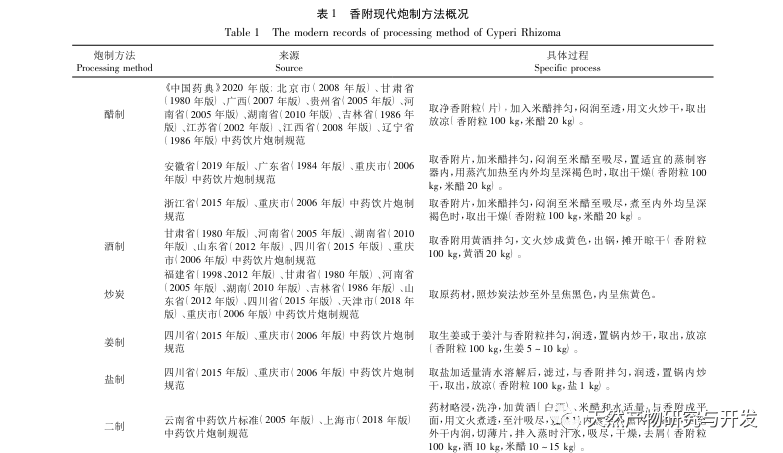
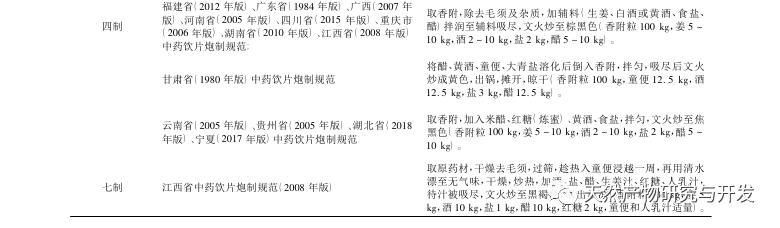
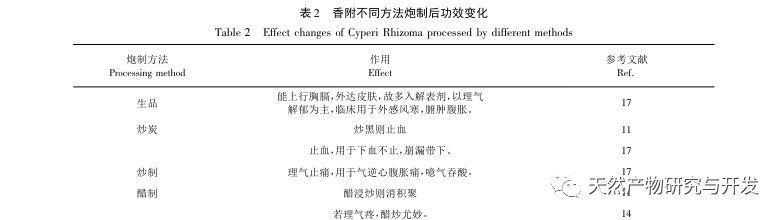
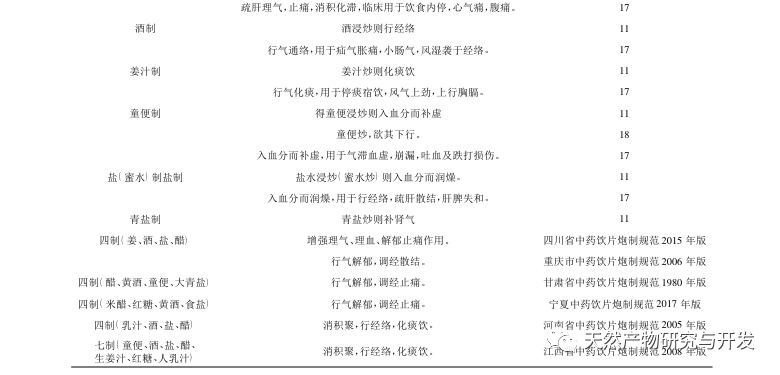
This article reviews the history and current status of the processing of Xiangfu, and finds that there are 8 processing methods in the processing standards of 23 provinces and cities collected nationwide. There are more than 20 processing methods in various dynasties, and the most commonly used ones are vinegar and four methods. It has been found that there are irregularities in the use of auxiliary materials in the processing of Xiang Fu. For example, due to inconvenient material collection and other reasons, the use of Xiang Fu has gradually decreased. Ginger, wine (or yellow wine), salt (or Daqing salt), vinegar, and honey are still auxiliary materials for Xiang Fu processing, and the specifications of the auxiliary materials are not specified. There is also a lack of uniformity in the processing methods, including mixing with auxiliary materials separately after roasting, different methods of processing several auxiliary materials step by step, and unclear parameters such as auxiliary material dosage, roasting temperature, and processing endpoint. In terms of efficacy and indications, there is no clear distinction between the efficacy and indications of different processed products and raw products. Different processing methods have not been clearly explained for enhancing different efficacy or producing new efficacy. Under the guidance of traditional Chinese medicine processing theory, combined with pharmacological experiments and quality markers, reasonable medicinal excipients and optimal processing methods should be screened, excipient standards should be formulated, and the processing specifications and quality standards of Xiangfu should be improved.
Volatile oil and the high content component α – coumarin in volatile oil are considered effective ingredients, but their content decreases during the processing. This suggests that the types and composition ratios of volatile oils may change or be converted into other components during the processing, and there is relatively little research in this area. When studying the effects of Xiangfu on the body, one or several active ingredients such as α – Xiangfu ketone, Xiangfu enone, and sugenol are often selected to study local physiological and pathological changes. The treatment process of traditional Chinese medicine is the intervention process of the drug system on the body system, and one or several monomers cannot fully represent the whole of traditional Chinese medicine.
Antidepressant and analgesic effects are two important pharmacological functions of Xiangfu. The analgesic mechanism of Xiangfu is mainly related to the inhibition of excessive secretion of prostaglandins. By inhibiting LPS induced COX-2 expression and negatively regulating NF – κ B signaling, it reduces the production of PGF2 α and PGE2, achieving analgesic effects; Analgesia is also related to regulating pathways such as inflammatory factors and the formation of new blood vessels in the body. Antidepressants are closely related to neurotransmitter secretion, including increasing levels of 5-HT, DA, and norepinephrine in mice, enhancing liver metabolism of LPS and glucose by targeting PAI-1, and regulating pathways such as adhesion plaques, neurotrophic factors, vascular endothelial growth factor, gonadotropin-releasing hormone, NOD like receptors, insulin, chemokines, and ErbB signaling. In mechanism research, most studies focus on the physiological changes of antidepressant or analgesic effects, while there is relatively little research on how drugs cause these physiological changes.
One of the reasons why traditional Chinese medicine exhibits certain medicinal properties is the comprehensive effect of specific substance composition and active ingredients. This specific substance composition includes the specific component composition in medicinal materials, as well as the composition system that changes after entering the body and interacting with the body. So the processing mechanism of traditional Chinese medicine should be combined with the process of changes in ingredients before and after processing, as well as the process of mutual influence between drugs and the body, including absorption, distribution, metabolism, and excretion in the body. The research on the processing mechanism of Xiangfu should focus on the efficacy of “soothing the liver, relieving depression, regulating menstruation, and relieving pain”, establish a pharmacological model that combines symptoms, study the transformation rules of chemical components before and after processing, absorption and distribution metabolism in the body, and changes in endogenous metabolism in the body, explore the correlation between changes in chemical components of Xiangfu, changes in medicinal properties after processing, and changes in endogenous metabolism in the body, reveal the scientific connotation of Xiangfu processing, and provide reference for the inheritance and innovation of traditional Chinese medicine processing, the selection of clinical decoction pieces, quality control, and new drug development.

 English
  Danish
  German
  Hungarian
  French
  Russian
  Spanish
  Turkish