
Evaluation of the quality of lotus flowers from different origins based on fingerprint spectrum combined with chemical pattern recognition method
Sleeping lotus is a perennial aquatic herbaceous plant in the family Nymphaeaceae, native to Ili, Altay, Bohu, and other areas in Xinjiang. The dried flower buds of the Sleeping Lotus, as a commonly used medicinal herb in Uyghur medicine, have been included in the Uyghur Medicine Volume of the Drug Standards of the Ministry of Health of the People’s Republic of China. They have the effects of reducing fever, relieving cough, clearing heat and detoxifying, calming the mind, and can be used to treat headaches, fever induced cough, acute and chronic wind shock in children caused by fever. Sleeping lotus mainly contains flavonoids and phenolic compounds. Modern pharmacological studies have shown that it has various biological activities, such as antioxidant, anti-inflammatory, hypoglycemic, antiviral, etc. In order to better control the intrinsic quality of the Chinese medicinal herb, this study intends to use fingerprint spectrum combined with chemical pattern recognition method to conduct multi-component content determination, comprehensively analyze the differences in the composition of Chinese medicinal herbs in different production areas, clarify the differences in production areas and characteristic components, provide reference for the identification and quality standard formulation of Chinese medicinal herbs, and lay a foundation for further development and utilization.
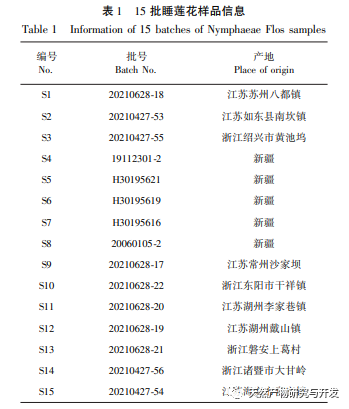
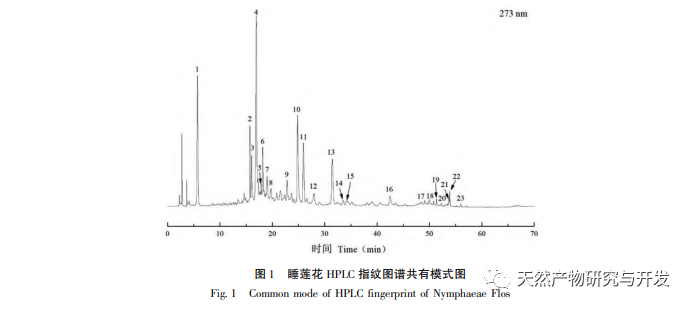
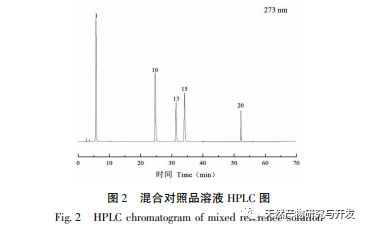
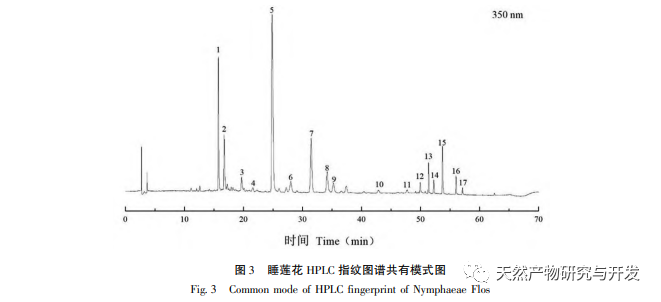
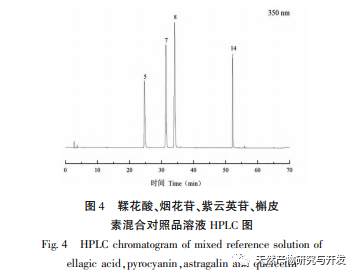
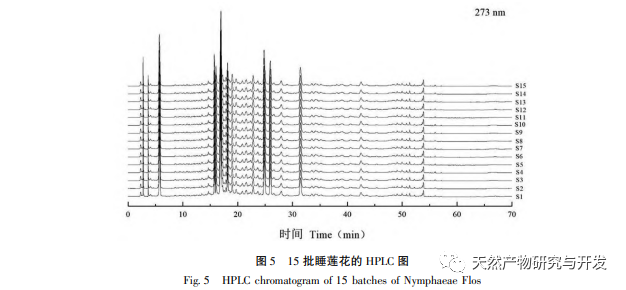
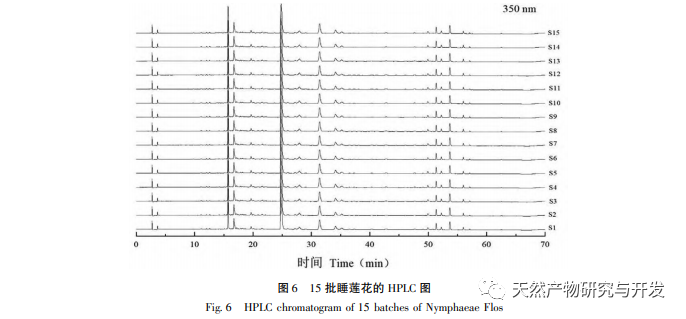
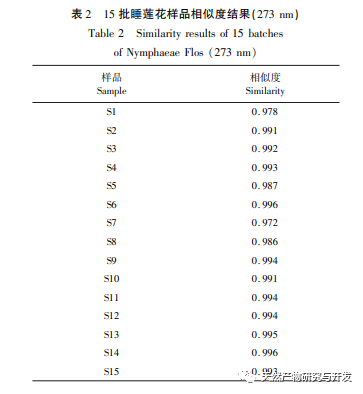
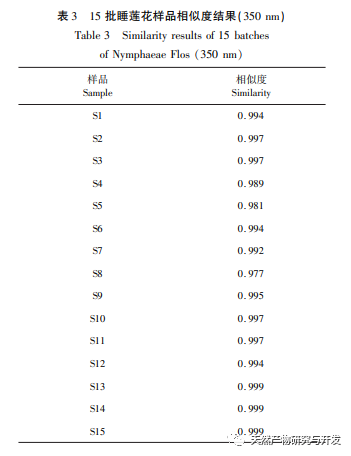
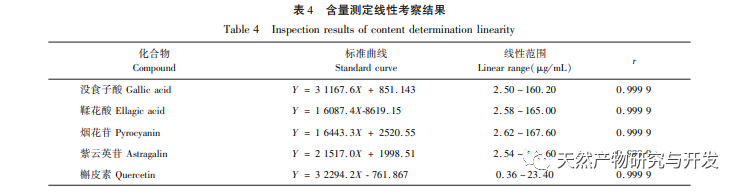
Selection of extraction solvent. There are many chemical components and different properties in the medicinal herb of Sleeping Lotus. In order to better reflect the information of the chemical components contained in the medicinal herb in the chromatogram, this article consulted a large number of literature and selected methanol, 50% methanol, and ethanol as the extraction solvents in this experiment. When using 50% methanol and ethanol as the extraction solvents, due to the analysis of the fingerprint spectra of 15 batches of Sleeping Lotus, it was found that there were 23 common peaks at a wavelength of 273nm. Peak 1 had good separation of gallic acid and a large peak area, so it was used as a reference peak. There are 17 common peaks at 350nm, among which 4 components have been identified, namely tannic acid, firework glycoside, purple cloud glycoside, and quercetin. Meanwhile, the similarity of the fingerprint spectra of 15 batches of samples was evaluated, and the results showed good similarity with the control fingerprint spectra. The small number of peaks leads to incomplete extraction. Through comprehensive analysis of various factors, the optimal extraction method using methanol as the solvent was determined.
Selection of detection wavelength. This study used a diode array detector to perform full wavelength scanning (190-800nm) on the fingerprint spectrum of the lotus flower. Based on the presented 3D spectrum, it can be seen that the chromatographic peak separation is high, the peak symmetry is good, the baseline is stable, and the peak capacity is large under the wavelength conditions of 273nm and 350nm. The obtained spectrum of the test solution can display richer information. Therefore, 273nm and 350nm were selected as the measurement wavelengths.
Selection of chromatographic conditions. The influence of methanol and acetonitrile as mobile phases on the fingerprint spectrum of lotus flowers was investigated. When using methanol and acetonitrile as mobile phases for isocratic analysis, the separation efficiency is poor. In order to achieve better separation of each chromatographic peak, gradient elution is chosen. Compared with methanol acetonitrile as the mobile phase, more chromatographic peaks can be obtained in the fingerprint chromatogram. By comparing the chromatograms obtained from two different mobile phases, it was found that the separation performance using acetonitrile was better than that of methanol. Therefore, acetonitrile was chosen as the mobile phase for this study.
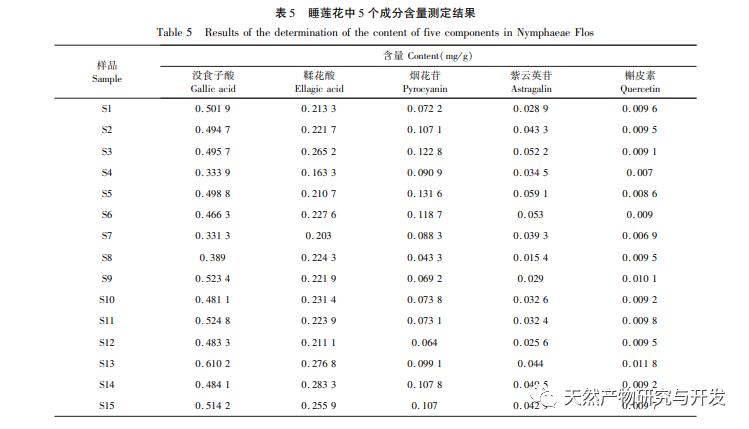
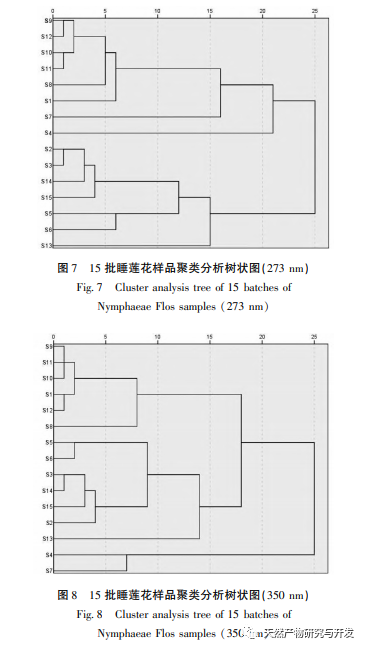
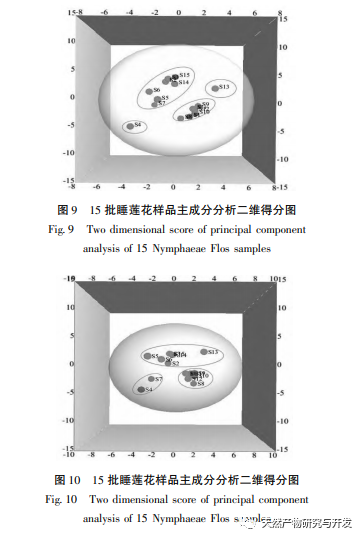
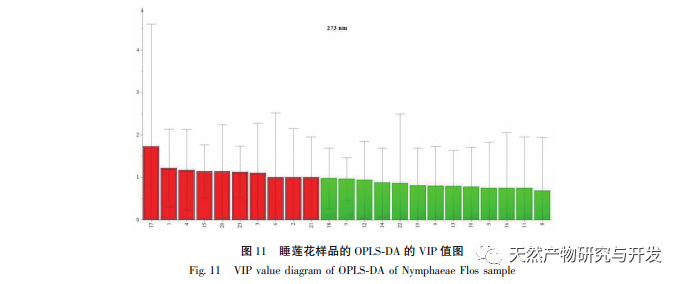
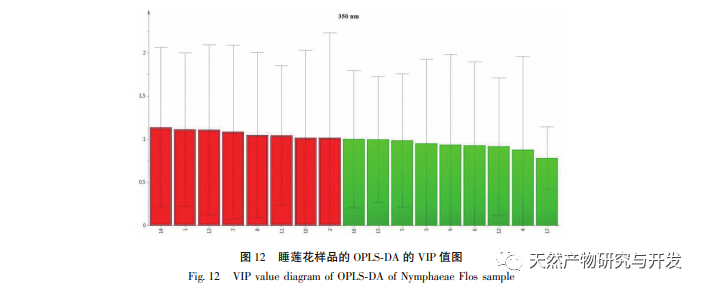
Evaluation of analytical methods. By analyzing the fingerprint spectra of 15 batches of sleeping lotus flowers, it was found that there were 23 common peaks at a wavelength of 273nm. Peak 1 had good separation of gallic acid and a large peak area, so it was used as a reference peak. There are 17 common peaks at 350nm, among which 4 components have been identified, namely tannic acid, firework glycoside, purple cloud glycoside, and quercetin. Meanwhile, the similarity of the fingerprint spectra of 15 batches of samples was evaluated, and the results showed good similarity with the control fingerprint spectra. The combination of HPLC fingerprint and cluster analysis, PCA, OPLS-DA can be used for clustering and component discrimination analysis of medicinal materials from different origins and batches. This study used chemical pattern recognition methods to conduct cluster analysis, PCA, and OPLS-DA classification patterns on the medicinal herb of Nelumbo nucifera. The analysis results of the three methods were consistent. Fifteen batches of Nelumbo nucifera were divided into four categories at 273nm, with differences mainly reflected in peaks 17, 1, 4, 15, 20, 23, 3, 6, 2, and 21. Among them, peak 1 was gallic acid, peak 15 was puerarin, and peak 20 was quercetin. At 350nm, it is divided into three categories, with differences mainly reflected in the screening of peaks 14, 1, 13, 7, 8, 11, 10, and 2. Among them, peak 14 is quercetin, peak 7 is firework glycoside, and peak 8 is purple cloud glycoside. These components can serve as the main characteristic components for distinguishing and identifying the quality of lotus medicinal materials from different production areas. Our research group will continue to conduct in-depth studies on unknown differential components in order to provide a more comprehensive reference for evaluating the quality of lotus medicinal materials.

 English
  Danish
  German
  Hungarian
  French
  Russian
  Spanish
  Turkish