
Pepper (Piper nigrum L.), also known as black Chuan, white Chuan, king pepper and floating pepper, known as the “king of spices” reputation, is a perennial evergreen vine plants. Pepper is native to India, mainly distributed in tropical and subtropical regions, the main countries of India, Indonesia, Vietnam, Brazil and China.
In China, pepper is mainly distributed in Guangxi, Guangdong, Yunnan, Hainan and Taiwan, etc. In recent years, for the domestic and foreign on the chemical composition of pepper, physiological function and its application of the research progress of the review, in order to provide a basis for the rational development and utilization of pepper resources.
Classification and Nutritional Composition of Pepper
According to different processing methods, pepper can be divided into black pepper, white pepper and green pepper.
Black pepper is dried directly from pepper fruits without peeling, and the Ministry of Health of China included it in the catalog of Chinese medicine for dual-use in 2002.
White pepper is made by peeling and drying the fresh fruits of pepper.
Green peppercorns are made from seven- or eight-ripe peppercorns that have been pre-treated and dried.
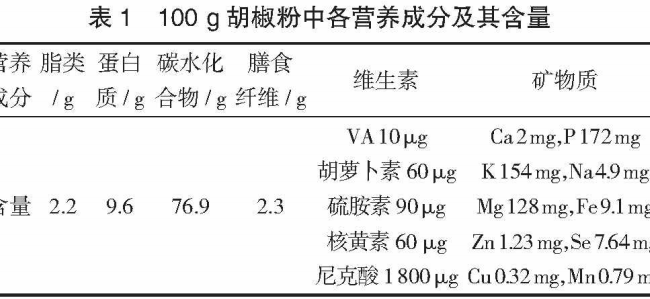
From the Chinese Food Composition Table, it can be seen that pepper is rich in nutrients (see Table 1) and a variety of biologically active components, including alkaloids, volatile oils, organic acids, coumarins, phenolic compounds, flavonoids, saponins, sterols, etc., of which the volatile oils, alkaloids and organic acids contain a variety of substances. 100g of pepper in the nutrients and their contents are shown in Table 1.
Physiological functions of pepper
According to “Compendium of Materia Medica”, “Materia Medica” and other materials, pepper is hot and pungent in nature, has the function of warming the middle and dispersing the cold, strengthening the stomach and relieving pain, and is mainly used for treating coldness in the spleen and stomach, vomiting and diarrhea.
It is because of the above bioactive components, pepper has antibacterial, antioxidant, anti-inflammatory, anticonvulsant, anticancer, insecticidal and other physiological functions, the main physiological functions are described below.
2.1 Bacteriostatic effect
Pepper has a broad-spectrum bacteriostatic, pepper fruit, pepper leaf extracts of certain plant pathogenic bacteria and common microorganisms in food have strong bacteriostatic effect.
It is reported that the essential oil of black pepper has an inhibitory effect on the growth of mycelium of five pathogenic bacteria, namely, pear black spot fungus, wheat erythromycetes, tomato gray mold fungus, chili wilt fungus and watermelon wilt fungus, and the inhibition rate of acetone extract of pepper leaves on the growth of mycelium of Dioscorea anthracnose can reach 83.64%;
Pepper extracts inhibited Escherichia coli, Bacillus subtilis, Staphylococcus aureus, Salmonella, Saccharomyces cerevisiae and Aspergillus niger;
The ethanol extract of Piper betle also showed strong inhibitory effect on 176 bacterial strains of 12 different genera from the oral cavity.
2.2 Antioxidant effects
Black and white pepper essential oils have the ability to scavenge superoxide anion radicals, scavenge hydroxyl radicals and resist linoleic acid lipid peroxidation. Within a certain concentration range, the ability of black and white pepper essential oils to scavenge superoxide anion radicals is stronger than that of BHT, PG and VC, and the antioxidant property of black pepper essential oil is stronger than that of white pepper essential oil.
2.3 Antitumor activity
The antitumor activity of pepper is mainly attributed to the piperidine-containing alkaloid components, piperine has the antitumor activity of inhibiting the proliferation and inducing apoptosis of human gastric cancer SGC-7901 cells, human HePG2 hepatocellular carcinoma cells, and it has an obvious apoptosis-inducing effect on human hepatocellular carcinoma SMMC-7721 cells.
Development and utilization of pepper
3.1 Food primary processing field
Currently on the market, black and white pepper grains and black and white pepper is the most common pepper primary processing products, in the field of food mainly plays the role of seasoning, whether cooking chicken, frying fish, marinated duck, soup, or stir-fried vegetables, boiled radish, stewed lotus root, etc., in the dishes in the appropriate amount of pepper can be put in the fishy, fragrant, inhibit the odor and greasiness.
Pepper in Western cuisine, especially Western meat processing is a very important raw material, creating a series of black pepper products, including “black pepper beef double humerus” “black pepper duck” “black pepper money belly ” “Black pepper duck breast seasoning products” and “black pepper steak” and other products, of which “black pepper steak” is the most familiar and one of the most popular products in Western cuisine. Among them, “Black Pepper Steak” is one of the most familiar and popular products in Western cuisine.
3.2 Food deep-processing field
Among the deep-processed products of pepper, piperine, white pepper oil, black pepper oil, white pepper oleoresin, black pepper oleoresin and black pepper extract have been included in the standard for the use of food additives (GB 2760-2104). In pepper oleoresin, it contains almost all the aroma and spicy substances in pepper, and its flavor and aroma are equivalent to 50 times the quality of pure pepper original powder, which can be used in food directly instead of pepper.
According to the physiological functions of pepper, pepper can be developed into functional foods for anti-gastric diseases, gastric ulcer, atherosclerosis, epilepsy, convulsions, tumors, chronic sinusitis, depression, as well as a series of functional foods for regulating blood lipids, brain function and immunity.
The use of pepper (alkali / oleoresin) can be made for rheumatism, diarrhea, pain, radiation, emergency effects, obesity, oxidative activity, as well as the regulation of menopause, blood sugar, male sexual dysfunction and other 10 types of functional food.
3.3 Food preservation field
Spices in addition to giving food in the sensory special flavor, but also has the function of antibacterial antiseptic. The use of 0.2g/100mL of the aqueous extract of white pepper treatment of cooled pork through the spine meat has a good preservation effect, white pepper and cinnamon alcohol soluble extract of chilled chicken has a preservation effect. The development of pepper as a preservative is another way to improve the economic value of pepper.

 English
  Danish
  German
  Hungarian
  French
  Russian
  Spanish
  Turkish