
National Announcement
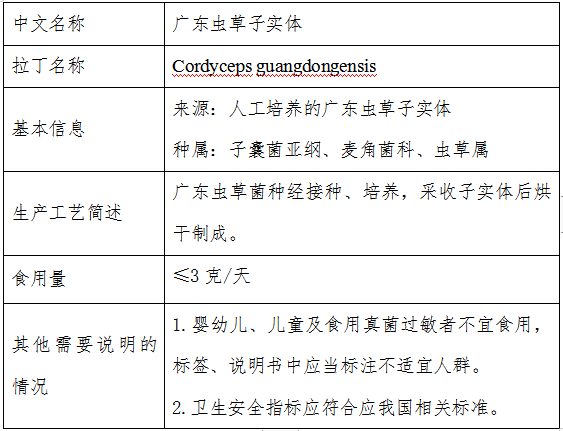
On January 4, 2013, the Ministry of Health (MOH) issued the Announcement on Approval of 7 New Resource Foods including Camellia sinensis (MOH Announcement No. 1 of 2013), officially approving Camellia sinensis, Saltine Pongamia Seed Oil, Meitango Fruit Oil, Saltine Wood Fruit Oil, Guangdong Cordyceps Seed Entity, Açai Fruit, and Teasel Leafy Laminaria Fermentation Mycelium as New Resource Foods and making explanations on their sources, species, production processes, serving sizes, The source, species, production process, serving size, applicable people, etc. are described as follows.
Rich in nutrients
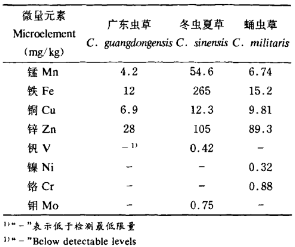
1、Comparison of trace element content between Guangdong Cordyceps and Cordyceps and Chrysanthemum Cordyceps
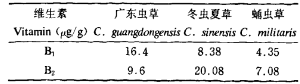
2、Comparison of vitamin content between Guangdong Cordyceps and Cordyceps and Chrysanthemum Cordyceps
3, rich in crude polysaccharide, cordyceps acid, adenosine, total flavonoids, triterpenes and sterols
Crude polysaccharide:
Polysaccharide is the main component in the hot water extract of Cordyceps sinensis in Guangdong Province and this component has significant anti-fatigue effect (Yan et al., 2013).
Cordyceps acid:
Cordyceps sinensis fruiting bodies contain a variety of organic acids, including gallic acid, chlorogenic acid, etc., which have antitumor, antioxidant, anti-free radical, antiviral and other effects.
③ Adenosine:
Currently known Guangdong cordyceps nucleosides mainly include adenosine, uridine, hypoxanthine, adenine, guanine, uracil and thymine. It has been shown that these nucleosides have a wide range of physiological functions such as anticancer, hypolipidemic, hypoglycemic and so on.
④ Total flavonoids:
Guangdong Cordyceps seeds contain a variety of flavonoids, including lignans, naringenin, apigenin, etc. These substances have antioxidant, anticancer, prevention of cardiovascular and cerebrovascular diseases and other effects.
⑤ Sterol metabolites
The sterol substances in the substrate of Cordyceps sinensis in Guangdong are rich and diverse, and their effects are also different. Among them, ergosterol is an important component of Cordyceps fungi (many Cordyceps fungi can produce ergosterol), which has the effects of anti-cancer, anti-virus, anti-arrhythmia and so on.
4, adenosine, cordycepin, cordycepic acid content comparison of Guangdong Cordyceps active active ingredients closer to Cordyceps Sinensis
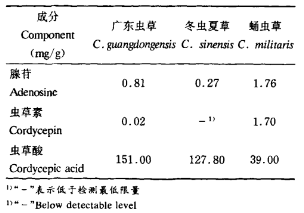
① The content of cordyceps acid was close to that of natural Cordyceps sinensis and much higher than that of Cordyceps chrysanthemi (Cai Zhongjun et al., 2003).
(ii) The content of cordycepin and adenosine was lower than that of Cordyceps chrysanthemi and closer to that of Cordyceps sinensis (Lin Qunying et al., 2009).
③ Fatty acid composition was basically the same as that of Cordyceps sinensis.
④ The crude protein content (0.5%) was 1.2% and 3.2% higher than that of Cordyceps chrysanthemi and Cordyceps sinensis, respectively.
⑤ Vitamin B1 content was higher than that of Cordyceps sinensis and Cordyceps chrysanthemi (Lin Qunying et al., 2009)

 English
  Danish
  German
  Hungarian
  French
  Russian
  Spanish
  Turkish