
With the rapid development of food science and technology, the globalization of the food supply and the need for more food sources, the sources, types and range of food ingredients are expanding. In order to regulate the development and application of food ingredients and to ensure food safety, new food ingredients (novel food) are usually subject to pre-market evaluation and approval before they are allowed to enter the market.
Development of the management system
China’s management system for new food ingredients has roughly gone through three major stages: the Measures for Hygienic Management of New Resource Foods during the period of the Food Sanitation Law (Trial), the Measures for Hygienic Management of New Resource Foods and Measures for the Management of New Resource Foods during the period of the Food Hygiene Law, and the provisions related to new food ingredients during the period of the Food Safety Law (revised in 2015).
In 1983, China promulgated the Food Hygiene Law (for Trial Implementation), of which Article 22 stipulates that food produced using new resources must be approved by the health department, thus initially determining the basic management system for new resource foods.
In 1987, in order to coordinate with the implementation of the Food Hygiene Law (for Trial Implementation), the former Ministry of Health issued the Measures for the Hygienic Management of Foods from New Resources, which made specific requirements for the approval procedures of foods from new resources.
In 1990, the former Ministry of Health revised the Measures for the Hygienic Management of New Resource Foods, and at the same time formulated the Procedures for the Examination and Approval of New Resource Foods, and the Food Sanitation Law was formally implemented in 1995, article 20 of which stipulates that the use of new resources for the production of food products must be submitted for examination and approval in accordance with the stipulated procedures prior to production.
In 2007, the former Ministry of Health issued and implemented the Measures for the Administration of New Resource Foods, which stipulated the definition, safety evaluation, application and approval of new resource foods, and at the same time formulated the accompanying Procedures for the Safety Evaluation of New Resource Foods and Provisions on the Declaration and Acceptance of Hygiene Permits for New Resource Foods, which incorporated the relevant requirements of the Administrative License Law.
In 2009, China promulgated and implemented the Food Safety Law, in which Article 44 proposed that the production of food using new food raw materials should be applied to the former Ministry of Health, and that approval could only be granted if the safety assessment was in line with food safety requirements.
In 2013, the former National Health and Family Planning Commission issued and implemented the Provisions on Declaration and Acceptance of New Food Ingredients and Administrative Measures for the Review of the Safety of New Food Ingredients (hereinafter referred to as “Administrative Measures”), which redefined new food ingredients and revised the review procedures and safety evaluation requirements.
In 2015, China amended the Food Safety Law and retained the relevant provisions on the management of new food ingredients in Article 37.
Changes in name, definition and scope
With the change of China’s new food ingredients management system, the name of new food ingredients has also undergone a change from “new resource food” to “new food ingredients”, and the connotation and scope of the concept of new food ingredients have also changed accordingly. The changes in the definition of new food ingredients in China are shown in Table 1.
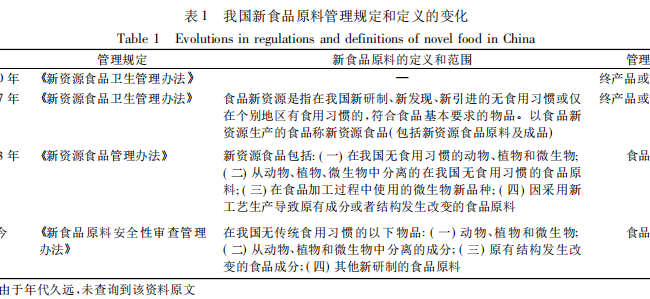
In accordance with the provisions of the definition and scope of new food ingredients, new resource foods in the Measures for the Hygienic Management of New Resource Foods issued in 1990 are foods produced from new food resources, while new food resources emphasize the characteristics of new discovery, new development and new introduction as a means of distinguishing between new resource foods and ordinary foods.
Under the provisions and guidance of this definition, new resource foods approved before 2007 included food raw materials, such as oligosaccharides, seaweed sugar, chrysanthemum cordyceps substrates, etc., and a large number of end-products, such as Tianfu Cola, Zhenhua 851 Oral Liquid, Organic Germanium Drinks, etc.
The 2007 revised Measures for the Administration of New Resource Foods modified the definition of new resource foods to include four categories, namely, animals, plants and microorganisms not customarily consumed; their isolated extracts not customarily consumed; new varieties of microorganisms used for processing; and food raw materials whose production by a new process has resulted in a change in composition or structure. Under this definition, all new food ingredients announced since 2008 are in the form of food ingredients.
The definition of new food ingredients in the Administrative Measures published and implemented in 2013 still provides for four categories. Compared with the definition in the Administrative Measures for New Resource Foods in 2007, the 2013 Administrative Measures deleted “new varieties of microorganisms for processing” and added “other newly developed food ingredients”. Another important change is that in the 2013 Administrative Measures, “new species of microorganisms for processing” was deleted and “other newly developed food ingredients” was added.
Another important change is that the 2013 Administrative Measures added the definition of “traditional use habit”, i.e. “refers to a food product that has a history of more than 30 years of production and operation as a stereotyped or non-stereotyped packaged food product within the area under the jurisdiction of a province and has not been included in the Pharmacopoeia of the People’s Republic of China”. “. Since the definition of new food ingredients is based on the premise of “no traditional consumption habits”, this definition further clarifies the boundary between new food ingredients and common foods.
In addition, with the improvement of the national food safety standard system and related management measures, new food ingredients are also clearly distinguished from food additives, nutritional enhancers and health foods. Substances that have been approved as food additivescan no longer be declared as new food ingredients.
Since 2009, substances that have been listed in GB 14880-2012 National Standard for Nutritional Fortification for Food Safety cannot be declared as new food ingredients. The former Ministry of Health Announcement No. 14 of 2009 explicitly stated that items limited to health food raw materials are not included in the scope of acceptance and evaluation of administrative licenses for new resource foods.
 English
  Danish
  German
  Hungarian
  French
  Russian
  Spanish
  Turkish